Chapter 18 of 23
Ringed Owls: Meet Mia, Buster, LK and 3F
What a handful of little rings can tell us about my own owls, and about the species
About 18 minute read
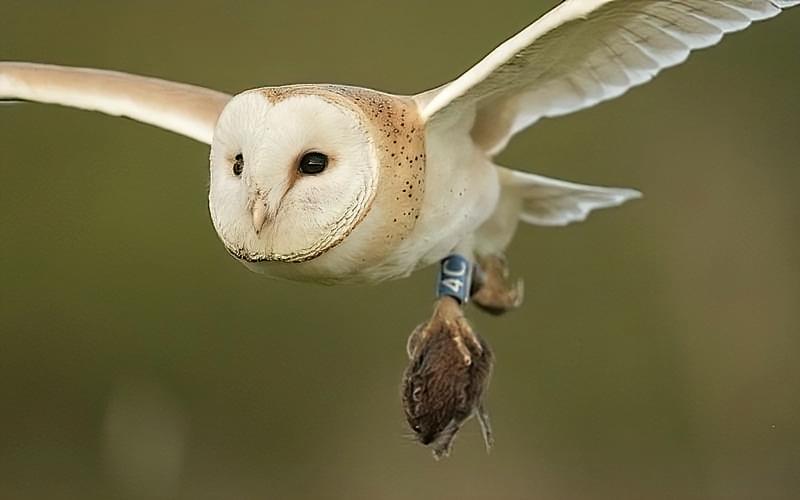
Some of the owls on our cameras wear jewellery. Look closely at one of my owls and you may see a bright blue ring with two characters on it. Look at another and you will see only a plain metal ring. Those rings are not decoration. They are part of a scientific scheme that helps us understand where young Barn Owls go, how long they live and what happens to them along the way.
My nest boxes are in the Hope Valley area of the Peak District, and a local group of volunteers has now identified four owls that have used them, not just two. In this chapter I will introduce them, explain how ringing works in the UK, and share what the ringers and other researchers have found. If you ever spot a ringed owl yourself, the last section tells you exactly what to do.
What is bird ringing?
Bird ringing is one of the oldest ways we have of finding out what wild birds get up to. In Britain and Ireland it is organised by the British Trust for Ornithology, the BTO, and it has been going for more than a hundred years. Every year over 900,000 birds of all kinds are ringed by more than 2,500 trained ringers, and most of them are volunteers.
Each bird gets a light metal ring with its own number. Every time someone catches, finds or reads that number, it adds a clue about where the bird was, when, and what it was doing. Put thousands of those clues together, and you begin to see how long birds live, how far they travel and what stops them getting there.
Ringing Barn Owls
Barn Owls are fully protected by law, and it is an offence to disturb one at or near a nest without a licence. So the people who ring them are experienced, trained and licensed. Ringers usually ring the chicks while they are still in the nest, because then you know exactly when and where the bird hatched. They work quickly and carefully, and leave the family in peace. They also count the brood, which is how we know how many chicks a typical nest raises in an area, and that turns out to be an important clue about how the owls are doing.
Two kinds of ring
An owl can wear two very different kinds of ring, and the difference matters when you are trying to work out who is who.
| Feature | Metal ring | Colour ring |
|---|---|---|
| What it is | A light metal ring with a unique number, fitted by a licensed ringer | A plastic ring with letters or numbers, worn as well as the metal ring |
| Who fits it | Ringers across the country, under the BTO scheme | Individual projects and groups, each with its own colours and codes |
| Can you read it? | Rarely. The number wraps round the leg, so you usually need the bird in the hand or a lucky photograph | Often, with binoculars, a telescope or a camera, without catching the bird |
| Where to report it | The BTO, through EURING | The project or local ringing group, or the BTO |
The Sorby Breck Ringing Group
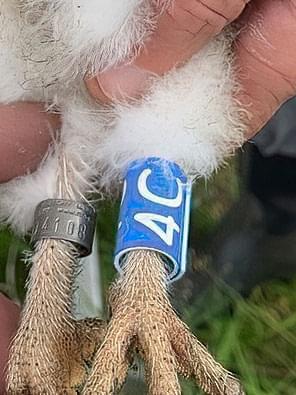
Mia, Buster, LK and 3F have all been ringed by the Sorby Breck Ringing Group, and I want to say a proper thank you to them. They are a group of bird ringers based around Sheffield and north Derbyshire, who work across Derbyshire and South Yorkshire. They are an independent group, affiliated to the Sorby Natural History Society, and part of the national network of ringing groups that feed their results into the BTO's database.
The group was formed in 1979, when the Sorby Ringing Group and the Breck Ringing Group joined together. Each of them was ringing about 1,000 birds a year, and the totals have grown steadily since. Their aim is to provide data from ringing to support the conservation and knowledge of birds in Derbyshire and South Yorkshire. They run ringing stations across the area every month, hold ringing demonstrations, and ring everything from tits and warblers to swans and owls. One of their recoveries was a Fieldfare ringed in Derbyshire in October 2020 that was later found in Finland, 1,974 kilometres away.
Like so many wildlife organisations and charities, all of this is unpaid. It takes many hours of training to become a licensed ringer, and the ringers do it in their own time, because they love wildlife. It is easy to forget how much of what we know about our birds comes from people like this.
For the last three years, the group has been part of the Northern England Raptor Forum's colour ringing project for Barn Owl chicks. As well as the usual metal ring, each owlet gets either a blue ring with white letters, or an orange ring with black letters, worn on the left leg. The big idea is to find out how far young owls travel after they leave the nest. It is generally believed that most move between about 9 and 14 kilometres from where they hatched, but nobody knows the whole story.
For me, the group has turned four anonymous owls into individuals with histories. For Buster, I pieced his ring number together myself, from a series of CCTV screenshots taken over several visits, and then got his full details from the BTO, with the Barn Owl Trust pointing me in the right direction. For Mia, and for the two new arrivals below, a member of the group, Bryn Roberts, kindly sent me their details directly.
Mia and her blue ring

Mia's blue ring read 4C. The group told me she hatched in a brood of four in 2024, on moorland a few kilometres from my boxes. It is only two characters, but that is the whole point. It was short enough to read from a distance, and big enough to show up in a photograph. You can see it in my pictures of her, and it meant that every time she landed on the perch or flew past a camera, I knew exactly who I was looking at.
Losing Mia
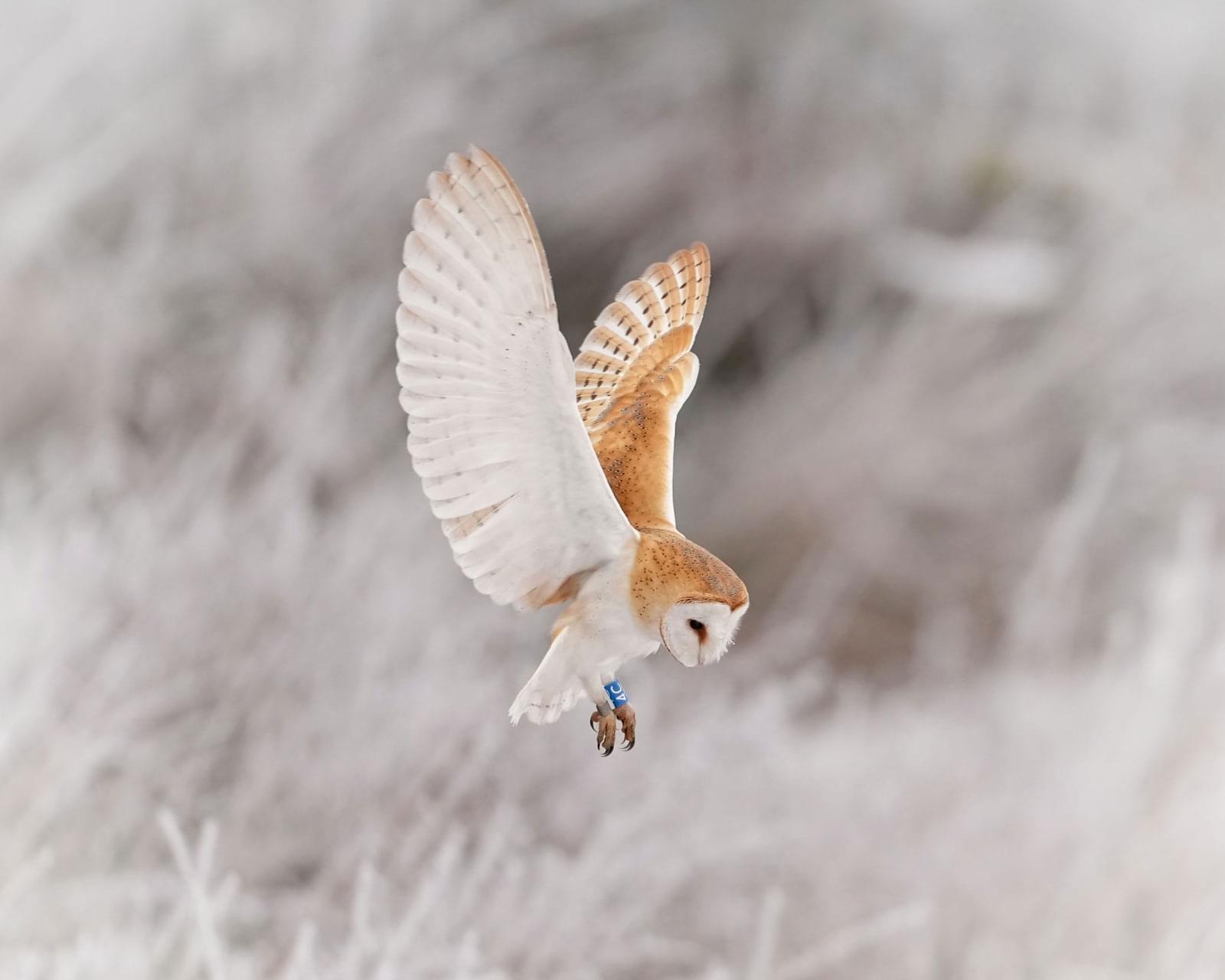
Sadly, Mia is believed to have been killed while she was out hunting. She was sitting on a wall when her distress call was heard, and it was loud enough to make Buster leave his nest box. A stoat or a red kite is the most likely culprit, as both had been seen around at the time.
Mia had a good history before that. She was one of four chicks that fledged from her natal box, and she went on to have a successful brood of her own with Buster. Sadly, one of her three siblings did not fare so well. It moved west after fledging and was killed in a road accident that September, a reminder of just how dangerous that first year on the wing can be. There was a change at Mia's old family box too. Her mother disappeared over the winter of 2024 to 2025, and a new female had taken over the box by the summer of 2025.
It is a sad reminder of how hard life is for a wild Barn Owl, even for one that knows its patch well. It is also why the ringers' work matters. Every ring that is read, and every loss that is reported, helps us understand what owls are up against.
Buster and the metal ring
Buster was ringed by the same group, but before the colour ringing project began, so he only ever had the traditional metal ring. That is a lot harder to read. The number is stamped right round the ring, so you only ever see part of it at once, and the ring is small, shiny and often at the wrong angle.
It took me plenty of patience. I took lots of pictures from my nest camera, and photographed the ring in different orientations, until I could put the whole number together. Then, with the help of the Barn Owl Trust, I got Buster's full details from the BTO. Here is his official record.
| Ring number | GY68782, a BTO metal ring |
|---|---|
| Species | Barn Owl |
| Ringed | 13 July 2023, as a nestling, by the Sorby Breck Ringing Group at a confidential site in Derbyshire |
| Found | 18 June 2024, nesting in one of my boxes with three owlets, with the ring number read from my camera |
| Time between | 341 days after ringing |
| Distance | In the same area as where he was ringed |
Buster is a survivor. The ringers quote studies suggesting that around 70 per cent of young Barn Owls do not make it through their first year, and many die on roads or from hunger. Buster made it through his first winter, and about a year after he hatched, he was raising a family close to where he was born. And he is still going strong. He has now raised three broods with three different females.
LK: a young owl on the move

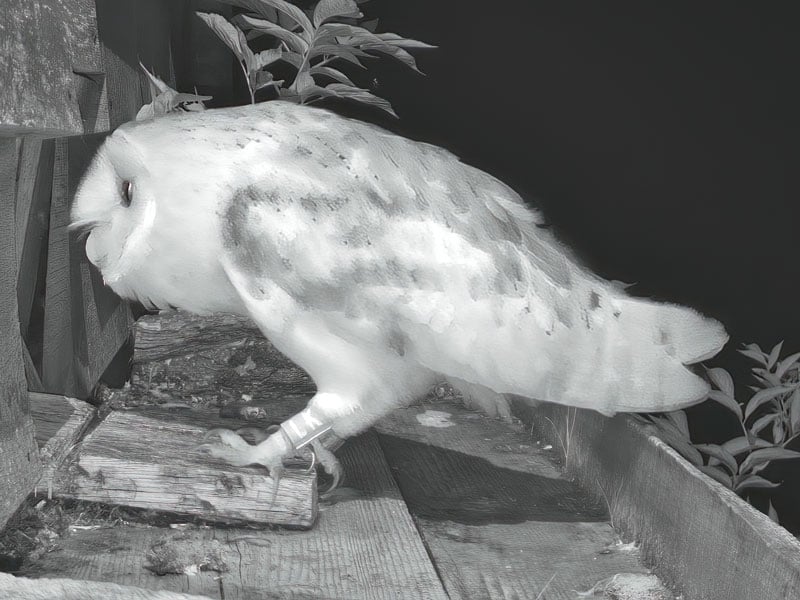
I also asked about another owl wearing a similar blue ring, this one reading LK. Bryn told me that LK hatched in 2025, in a brood of five, on another estate a few kilometres away. LK has since been spotted twice at one of my nest boxes, so it seems this young owl has found my land worth visiting. Bryn asked me whether I thought LK could be a male, which is a question I would love to be able to answer.
Both sightings were caught on camera. Once, LK turned up on Buster's favourite hunting post, and another time LK was peering into the entrance of Buster's own nest box, which made for a nervous few minutes of watching. Buster did not seem impressed by the visit.
A new arrival: 3F
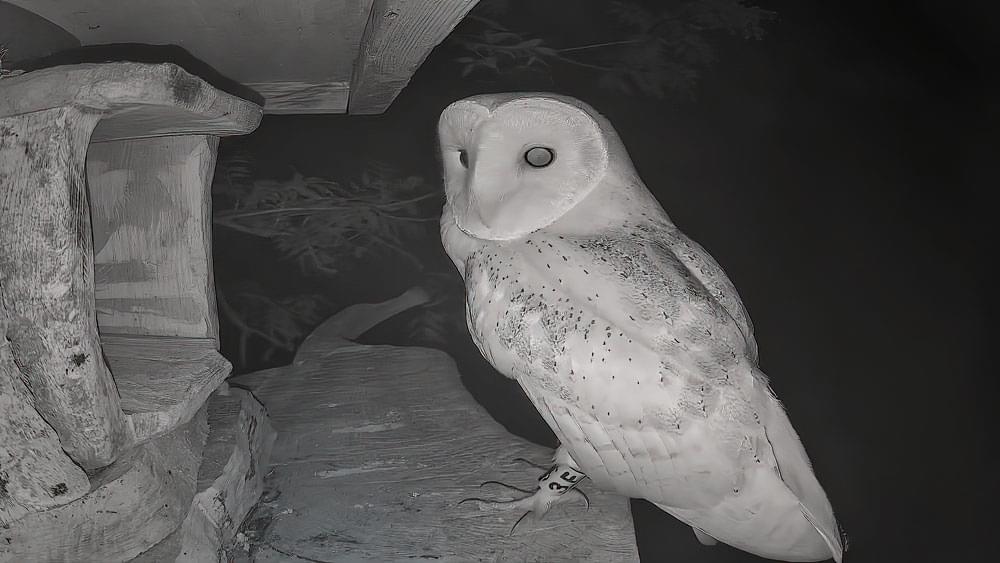
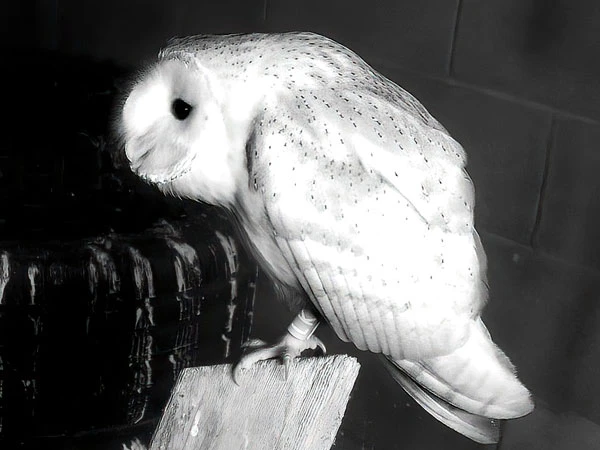
Since I first started keeping track of these owls, a third ringed owl has turned up on my cameras. This one hatched in 2026, so it is very young, and it comes from the Totley area near Sheffield. It was ringed by the same group, some distance from my boxes, which shows once again how far these young owls will explore before they settle.
On the night camera, I could just make out the letters and numbers on 3F's ring, in much the same way I once puzzled out Buster's. But because the camera works by infrared light at night, it cannot show colour, so I could not tell what colour the ring actually was. The Sorby Breck Ringing Group confirmed for me that 3F's ring is orange. It is a good reminder that photo identification from a night camera has its limits. You can read the ring, but you may not always know what you are looking at until someone who was there can tell you.
What the ringers have found
The Sorby Breck group's Barn Owl Report for 2026, written by Annie Adlington, gives a real picture of life for Barn Owls in the area where they work, and it is good news this time, after a much harder 2025. These are the parts that stood out for me. I have marked which figures are the group's own and which are national.
- More owlets ringed (the group’s own figures). The group colour ringed 94 owlets in 2026, almost double the 49 of two years before, and up from 62 in 2025.
- Bigger broods (the group’s figures). The average brood size rose to 4 chicks, matching the UK average, after 3.1 the year before.
- A kinder year (the group’s figures). 2026 had its own dry spell, but it came later in the year, after most broods had already been raised, unlike the early droughts of 2025.
- How far they go (local figures). Of 32 recovered birds, the median distance travelled was 11.1 kilometres, and 91 per cent stayed within 30 kilometres of home. Most that did move went south west, along the Derbyshire and South Yorkshire border.
- One remarkable journey (the group’s figures). One bird, ringed in Derbyshire, was found in a nest box in Powys, mid Wales, 184.7 kilometres away. That is more than ten times further than any other recovery.
- A hazard I had not thought of (the group’s figures). Two birds drowned in water troughs this year, and one in a water butt. Roads are still one of the biggest dangers, but water is an easy one to overlook.
- Roads (a UK estimate). The Barn Owl Trust estimates that of the roughly 12,000 young that Britain’s 4,000 pairs produce in a typical year, between 3,000 and 5,000 are killed on roads, mostly in autumn while young birds are dispersing.
Recoveries are still coming in as I write this, since Barn Owls are easier to spot in the shorter days of autumn and winter, so these figures are likely to grow before the year is out.
Other groups, other colours
The Sorby Breck group is not the only one doing this. Colour ringing of Barn Owls is spreading, and other groups run projects of their own. The Sussex Barn Owl Group, for example, fits its owls with a red ring with white letters on the left leg. So Mia's blue ring was one system among several. Closer to home, the Northern England Raptor Forum, which the Sorby Breck group is part of, has even started colour ringing kestrels, with black rings and white letters or numbers, so it is not just owls worth watching for now.
There is no single national code. Each project picks its own colours and letters, which means a ring only makes sense when you know the colour, the characters, which leg it is on and, ideally, which project it belongs to. Approved colour marking projects are listed on a European colour ring register, with a contact for each one, and the BTO explains more on its page about why birds are colour marked.
How far do young Barn Owls travel?
This is the big question that all these rings are trying to answer, and it is more interesting than you might expect. You will see different numbers quoted, depending on how and when they were measured.
- The average. The Barn Owl Trust puts the average dispersal distance for ringed chicks at about 7.8 kilometres, or 4.8 miles. Most move less than 10 kilometres, and a small minority go a very long way.
- The median. In the BTO's ring recovery work, the median distance between ringing and recovery for birds ringed as chicks rises from about 3 kilometres in the second month after fledging to about 12 kilometres by the fourth month. That is roughly where the 9 to 14 kilometres figure sits.
- When they go. Most of the moving is done within four or five months of leaving the nest. After that, adult owls hardly move at all, and a BTO analysis found that they shift only about 2.2 kilometres between breeding sites. Female chicks tend to travel further than males.
- The long haulers. A few owls travel far. The Barn Owl Trust lists Devon to Yorkshire, Germany to west Cornwall and the Isle of Wight to Normandy. One owl ringed at its nest in the Highlands in June 2007 was hit by a car 624 kilometres away in west Wales that December, and an owl ringed as a chick in Shropshire in 2015 was recaught alive 114 kilometres away in Warwickshire.
- Mainland Europe. Owls there often go much further, with more than 50 kilometres common, and the Barn Owl Trust says they disperse further in years when food is short.
- Sussex so far. In the Sussex colour ring project, two chicks moved more than 40 kilometres, four were seen 12 to 22 kilometres away and six roamed only 2 to 4 kilometres. The farthest recovery was 46 kilometres.
- The Sorby Breck group, in more detail. Using 32 recovered birds, the median distance was 11.1 kilometres, and 91 per cent stayed within 30 kilometres of where they hatched. One exceptional bird travelled 184.7 kilometres to mid Wales, more than ten times further than any other.
And what about my own owls? Here is something I find fascinating. Buster, Mia and LK all travelled only a few kilometres from where they hatched. According to the BTO, Buster was found nesting in the same area where he was ringed. Mia hatched a few kilometres from my boxes, and so did LK, whose home estate was the Longshaw Estate. That was where BBC Springwatch was filmed in 2025, chosen for its wildlife, and the National Trust said that barn owls and kestrels nest there.
Three owls is a very small sample, and I would not claim it proves anything. But it fits a simple idea. If there are good hunting grounds and safe roosting places close by, and there is enough food, why go anywhere else? A young owl that finds rough grassland full of voles and a dry, quiet place to sleep has everything it needs. The long journeys may be owls that found no room or not enough food at home. The Barn Owl Trust notes that in mainland Europe owls disperse further in years when food is short, although it says this does not seem to happen from year to year in Britain, so it is a lovely question for the ringers to keep working on.
Why colour rings are such a good idea
Most of what we know about dispersal comes from ring recoveries, and the Barn Owl Trust points out that those are largely birds that have died. That is useful, but it only tells us where an owl ended up. A colour ring means anyone with binoculars or a camera can identify a live bird without catching it, so the same owl can be seen again and again. That could tell us where young owls settle, how long they live and how many make it.
My guess is that as more groups adopt colour rings, and more people learn to look for them, we will slowly build up a much better picture of what Barn Owls do, based on sightings in the field. It is early days, and nobody has to use the same system, but every ring that is read helps.
What to do if you see or find a ringed bird
As winter gets closer and prey becomes harder to find, Barn Owls hunt more in daylight, which gives us more chances to see them. Whatever the ring looks like, this is what to do.
- Note the details. Write down the species, the colour of the ring, the letters or numbers, which leg it is on, whether there is a metal ring on the other leg, the date, the place and what the bird was doing. A clear photograph of the leg is often enough.
- Keep your distance. Never disturb a nest or try to catch a bird to read its ring.
- Contact the local ringing group. A Barn Owl colour ring is very likely to belong to a local project, so the local group may already know who is using that colour combination, and can tell you about the bird. You can find groups on the BTO ringing groups page.
- Report it to the BTO as well. For a colour ring, you can also look for the project on the European colour ring register, or use the EURING ring reporting website.
- If you find a dead ringed owl. The Barn Owl Trust asks for all dead Barn Owls in the UK to be reported to them, ringed or not, and birds with BTO rings should be reported through EURING.
- If it is alive but injured or in trouble. Contact a wildlife rescue or a vet for advice.
You can read the full story, with more links, in my article Barn Owl Ringing in the UK, and the group's whole report is on the website as the Barn Owl Report 2026.
A huge thank you to the Sorby Breck Ringing Group, the BTO and the Barn Owl Trust, who made these stories possible, and whose work helps every owl in the county.
See it happen live. Everything in this guide plays out on our cameras.
Watch the live nest Subscribe on YouTube Free PDF Find us on Facebook
Share this page: Facebook · WhatsApp
Free to read and share under a Creative Commons Attribution NonCommercial NoDerivatives 4.0 licence. Last updated September 2026 · Edition 1.0 · About 18 minute read