Chapter 7 of 23
How a Barn Owl Hunts
Patience, precision and a very good pair of ears
About 7 minute read
Watching a Barn Owl hunt is one of the great free shows of the British countryside. The bird works its way along a field edge like a person mowing a lawn, slow and steady and a few feet above the grass, then stops, hangs in the air and drops in a puff of feathers. It is such a familiar picture that it is easy to forget how remarkable it is. This chapter looks at how it all fits together.
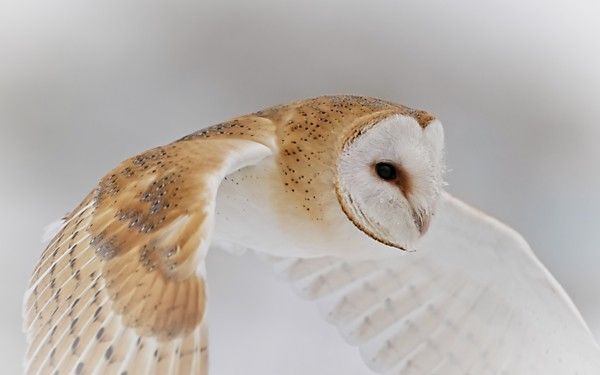
Quartering the ground
A hunting Barn Owl flies low. Most of the time it is no more than three metres off the ground, and often a good deal less, at around one to three metres. It has to be that low, because the sounds it hunts by are tiny, the rustle of a vole in grass or the faint squeak of a shrew, and they fade quickly with distance. The owl flies slowly, back and forth, covering an area again and again, a technique known as quartering. Because prey is hard to detect, an area may need several passes before the owl finds something. Its ground speed is usually somewhere between a standstill and about 16 kilometres an hour, and it is often a good deal slower than that.
When the owl hears something, it does not always dive straight away. More often it stops and hovers, holding its head perfectly still with its face pointing at the sound. It may drop a metre or so, hover again, and only then make the final pounce, with its feet thrust forwards and its wings raised. The owl's ears do most of the work here, and the eyes seem to help in the final moments. The whole thing is beautifully quiet.
Because the owl is often looking down and to the side, it is not always looking where it is going, and hunting owls do sometimes fly into fences, wires and even each other. The bird with its face pointed at the ground simply cannot see straight ahead.
Waiting on a post
A Barn Owl does not always hunt on the wing. Sometimes it perches on a fence post, a gate or a low branch and waits, scanning and listening until something moves. If nothing happens, it may try a different post or fly off to another favourite spot. This sit and wait approach is more common in cold weather. Flying burns energy and loses heat, and a bird sitting quietly on a post with its feathers fluffed up warms the air trapped in its plumage and wastes less. Posts of around two to three metres are ideal, since a low post gives only a limited range.
Owls are not all the same, either. Watchers have found that some individuals favour hunting on the wing, some prefer hopping from post to post, some work along ditches and some concentrate around farm buildings. Barn Owls also seem to avoid tall telegraph poles, which are much loved by kestrels and buzzards, presumably because a hunter that relies on its ears wants to be close to the ground.
Weather, wind and time of day
Barn Owls are creatures of the half light. They mostly leave the roost at dusk, hunt through the evening and again before dawn, and rest in between. But they are not strictly nocturnal. If food is short, or in the cold months, or when a pair is feeding hungry chicks, they hunt in daylight as well. In fact a Barn Owl hunting in broad daylight in winter is often a sign that it is struggling to find enough to eat, and not simply out for a stroll.
Rain is a problem for them. Wet feathers make an owl heavy and noisy, and the sound of rain on the ground and on vegetation masks the little noises the owl listens for. So they avoid hunting in rain, though they may occasionally work in light showers. A gentle breeze is helpful, because wind blowing up a slope gives them free lift. A strong wind, on the other hand, rustles all the grass and makes it hard to hear.
Interestingly, individual birds vary. Some are keen daytime hunters, and others stick strictly to the hours of darkness. Watch a particular owl for long enough and you will find it has habits of its own.
How well do they do?
A Barn Owl in good conditions can catch something every few minutes. Researchers who have watched breeding pairs closely have recorded a male bringing nine prey items to a nest in under an hour, and a busy pair may deliver seventeen items in a single evening. In the few weeks before the eggs are laid, a male may bring anything from ten to seventeen prey items in a 24 hour period. Once the owlets are growing, the number rises to around fourteen a day. That is a lot of voles.
A hungry family is a real test of a male's skill. Some are much better hunters than others, and researchers watching nest cameras have noted that some males are far more attentive and productive than their neighbours. A male in good condition, in good habitat, with plenty of prey around, has a big advantage.
The kill and the meal
A Barn Owl kills with its feet. It grabs the prey in its talons and squeezes harder each time the animal moves, which is usually quick and final. Young owls seem to know how to do this from the start. Owlets practise by gripping sticks, stones and even bits of pipe, and captive birds have been seen clutching and releasing dead prey over and over again. When a bird tackles something bigger, such as a young rat, it may also use its bill to give a sharp bite to the neck or head.
Once it has caught something, the owl usually mantles over it, holding its wings out and lowering its body to hide the prey from any rivals. A bird that is not mantling will do so at once if another owl comes near. Then it either eats on the spot or carries the prey home. A bird carrying food to a nest almost always holds it in one foot the whole way, and then swaps it to the bill at the entrance before going in.
A Barn Owl eats its prey whole, and it likes to swallow head first. The bird positions the animal in its bill, often with the help of a foot, then jerks its head forward and opens its bill to draw the animal in, bit by bit. When the prey is on the large side, the trick reverses, with the head jerking back so that momentum carries the animal down the throat. Swallowing head first means the fur lies flat and the legs fold back, so the animal slides down easily. Even owlets not much more than two weeks old can swallow small voles this way. Birds are different. A Barn Owl will usually pull the head off a small bird and eat the body in pieces.
Read more: Barn Owl Hunting on the website.
See it happen live. Everything in this guide plays out on our cameras.
Watch the live nest Subscribe on YouTube Free PDF Find us on Facebook
Share this page: Facebook · WhatsApp
Free to read and share under a Creative Commons Attribution NonCommercial NoDerivatives 4.0 licence. Last updated September 2026 · Edition 1.0 · About 7 minute read