Chapter 12 of 23
Growing Up
From a pink hatchling to a full grown owl in about ten weeks
About 7 minute read
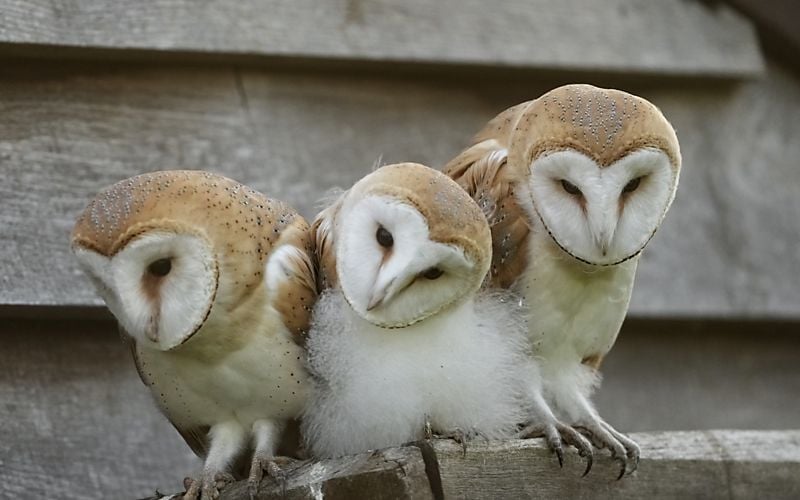
Few sights in nature are as charming as a nest full of Barn Owl chicks. They start as tiny scraps of pink and end up as fluffy white giants, and in between they go through some remarkable changes. Because they hatch one at a time, a single nest often has owlets of several different sizes, from a tiny newborn to a huge fluffy chick nearly ready to fly.

Hatching
Around 30 days after the first egg was laid, the first owlet is ready to hatch. It has a small, hard bump on the tip of its bill, called an egg tooth, which it uses to break through the inner membrane and then chip through the shell, a process known as pipping. The female can feel and hear what is happening, and she often helps by nudging aside pieces of cracked shell. It can take a day or more for the owlet to get free.
A newly hatched owlet is naked, pink and blind, weighs about as much as three or four sugar cubes, and is completely helpless. Within a day, a coat of short white down begins to sprout. The female breaks up small pieces of prey and feeds them to her newborn, and she stays close to keep the chick warm. Within a day or two, the owlet is calling for food, in a little shivery twitter which soon changes to the hiss and snore we met earlier.
Another egg hatches every two to three days, and so it goes, until the last one arrives a week or two later. Being first in line is a big advantage, and the oldest owlet gets a head start on food, size and strength.
The first weeks
In the first few weeks the female does most of the brooding, and the male brings all the food. The owlets grow quickly. Their eyes open at about ten days old, and shortly afterwards they start to shuffle around the nest. By the time they are two to three weeks old, they are strong enough to swallow small animals whole. Some owlets have been seen swallowing a shrew or even a small mouse at around two weeks, and by four weeks they can manage a medium sized field vole. It is remarkable to see a chick of only a few weeks manage a mouse almost as big as its own head.
At about three weeks, a thicker, warmer second coat of down grows in. The owlets no longer need constant brooding, and the female gets her first real chance to leave the nest and hunt. The chicks huddle together to keep warm on cold nights, and spread out and pant on hot days. By the time the youngest is three weeks old, the female has stopped brooding altogether and she often roosts elsewhere in the building or nearby.
The nest is not a tidy place, and yet it is oddly clean. The owlets produce very wet droppings with a strong smell, but the layer of fur and pellet debris soaks it all up, and the chicks stay remarkably dry. That distinctive, ammoniacal smell can hang around a nest long after the owls have left.
Nearly grown
At about a month old, the owlets are covered in thick white down and are surprisingly playful. They wrestle, hop, pounce on imaginary prey and pull at things with their beaks and feet, and they jostle for a place at the front when an adult arrives with food. By around 40 days, they have reached their full skeleton size and their maximum weight, and some are heavier than their parents, at over 400 grams. Then they gradually slim down, which is quite normal, and they lose a bit of weight before they fly.
From here, the flapping leads to jumping, the jumping leads to short hops and the hops lead to messy first flights. At around eight weeks old, most owlets are starting to fly, though at first only a short distance and often back to the nest again. After about ten weeks, they look a lot like adults, and they roost on one leg like their parents. They often sit on a ledge outside the nest at night, waiting for the parents to fly in and pass a vole straight from claw to claw.
Learning to hunt
As far as anyone knows, Barn Owls are not taught to hunt. Parents do not run lessons. Instead, the young learn by instinct and practice. They start by pouncing on blowing leaves and other bits of moving debris, and gradually work up to real prey. Young owls that were reared in captivity and released have done fine, and that is proof that the skills are built in. The parents keep bringing food to the nest for a good while after the young have fledged, and the young often come back to roost there for weeks.
Danger at the nest
Growing up in a nest has its risks. Owlets are curious, clumsy and often at the edge of the nest when the adults arrive. Between about three and eight weeks old, they are at risk of falling from the nest. It is not something the parents do deliberately, but the adults ignore any fallen owlet, and a young bird that cannot climb back up will not survive for long. Foxes take those that spend too long on the ground, and a buzzard has been seen grabbing a fledgling from a nest platform. This is why the design of a nest box matters, as we will see in chapter 15.
There are other risks too. In a poor year, when food is short or when weeks of rain have made hunting difficult, the youngest owlets may starve. Sometimes the older chicks will eat a sibling that has died or is dying, and sometimes the bodies are simply trampled into the nest. In lean years up to nearly half the chicks in a nest can die. In good years, only a small fraction do.
How many make it?
The number of owlets that survive to fly varies hugely from nest to nest and year to year. On average, a British nest holds around three owlets, and roughly two and a half of them fledge. But nearly three in every ten nesting attempts fail completely, and a lucky pair with lots of voles nearby may raise six or seven. A pair may occasionally raise a second brood in the same year when food is abundant, particularly if the first nest was early.
Leaving home
The last stage of the story is dispersal. From about twelve to sixteen weeks old, most young owls leave the area where they were born, usually in August and September. They go alone, at different times and in different directions, and they wander over an area they do not know. At first they may move a few hundred metres at a time, sleeping in trees and hedges, and gradually they explore further. In the first month, the typical distance from the nest is about three kilometres. By the third month it is about twelve.
Most young owls settle within ten kilometres of where they hatched, and a good many end up close to their parents. Many take over a site left empty when an adult has died, and pair up with the surviving bird. By the end of November, most have found a home. Getting there is the most dangerous stage of a Barn Owl's life, and more die during those months than at any other time. It is the story we turn to next.
See it happen live. Everything in this guide plays out on our cameras.
Watch the live nest Subscribe on YouTube Free PDF Find us on Facebook
Share this page: Facebook · WhatsApp
Free to read and share under a Creative Commons Attribution NonCommercial NoDerivatives 4.0 licence. Last updated September 2026 · Edition 1.0 · About 7 minute read