Chapter 11 of 23
Nests, Eggs and Incubation
How a family gets started
About 5 minute read
A nest that is not really a nest
A Barn Owl does not build a nest. There are no twigs, no grass, no feathers. What it does is settle in a dry, dark hollow and lay its eggs straight onto whatever is already there. In a barn, that may be old hay, straw or a beam. In a nest box or a tree, it is often the debris left over from the pellets the birds have coughed up during the previous months. Owls have been known to lay directly onto timber, loft insulation and even plasterboard.
As the breeding season begins, the female often spends time quietly in her chosen spot. She breaks up pellets with her bill and scrapes the older debris with her feet, and sometimes makes a slight dip in the middle. The soft, furry mix is warm and dry, and it soaks up the moisture from the owlets' droppings later on. It is a nest made of leftovers, and it works beautifully.
Where and when
Barn Owls nest in barns, farm buildings, church towers, hollow trees and nest boxes. They like a nest with plenty of room, and they prefer a place with a good view over rough grassland. The entrance should be sheltered from the prevailing wind and rain, so the best direction depends on where you live. Northeast is often suggested, and on my own land, boxes facing northwest have worked best. The entrance also has to be clear, so the birds can fly straight in without any obstruction.
The timing is hugely variable. The great majority of eggs are laid in April or May, but eggs have been recorded very early in the year and very late. Timing depends mainly on food and, to a lesser extent, the weather. Where voles are plentiful and the spring is warm, laying starts earlier. Young females breeding for the first time tend to lay around two weeks later than older, more experienced females.
The eggs
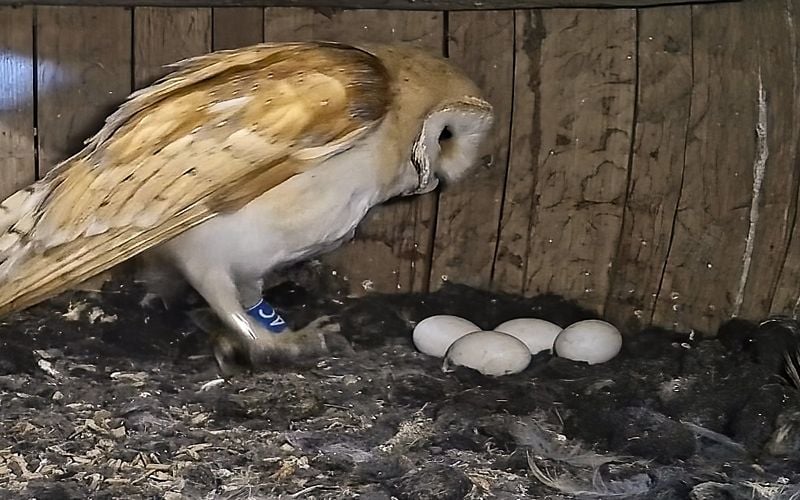
A Barn Owl egg is white, with a slightly dull, chalky finish, and around four centimetres long. As the weeks pass, it often becomes stained and grubby from the nest debris. A typical clutch is four to six eggs, and the average in Britain is a little under five, though clutches of three to seven are not unusual and a few nests have held more.
The eggs are laid at intervals of two to three days, which means that laying takes a week or two. And here is the twist that makes Barn Owls different from most birds. The female starts sitting on them straight away, as soon as the first egg is down. That means the first egg is well into its incubation by the time the last one is laid, and so the eggs hatch one at a time, in the order they were laid.
This is not a mistake. It is a clever piece of planning. If food turns out to be short, the oldest and biggest owlets get fed first, and the youngest go without. In a lean year, a few of the brood survive. In a good year, all of them do.
Sitting tight
Incubation takes about 30 to 32 days, and the female does all of the sitting. She rarely leaves, and she loses weight gradually through the weeks as she relies on the male to bring her food. A typical male delivers around eight to ten prey items in 24 hours at this stage, and he often leaves them in a heap by the nest, where they can wait if the weather turns bad. The female can begin to moult while she is on the eggs, so it is not unusual to find a big wing feather in the nest.
Because the male is the only source of food, he has to hunt for the female for a month, and then for the owlets for two months more. Adding that up, a male Barn Owl can be the sole provider for more than two months. He does his best, roosting close enough to see the nest, and often somewhere within the same building. If the nest box has a roosting ledge above the nest, it is usually where you will find him, with the female and owlets below.
Some eggs do not hatch. It is quite normal for one or two eggs in a clutch to fail, either because they were not fertile, or because they chilled, or because the female pushed them aside. On average, around three quarters of eggs hatch, and it is entirely usual to see an unhatched egg on the edge of a nest for the rest of the season. If food is very short, or a female is underweight, or the male has been injured or killed, a pair may give up on the whole clutch.
Disturbance
Sitting Barn Owls are sensitive to disturbance, and it is the male who usually flies off first when something unexpected happens. It is a time when the birds are at their most vulnerable, and it is also a time when they are strongly protected by law, as we will see later. If you think you have found a nest, the best thing you can do is to leave it alone and watch from a distance.
See it happen live. Everything in this guide plays out on our cameras.
Watch the live nest Subscribe on YouTube Free PDF Find us on Facebook
Share this page: Facebook · WhatsApp
Free to read and share under a Creative Commons Attribution NonCommercial NoDerivatives 4.0 licence. Last updated September 2026 · Edition 1.0 · About 5 minute read