

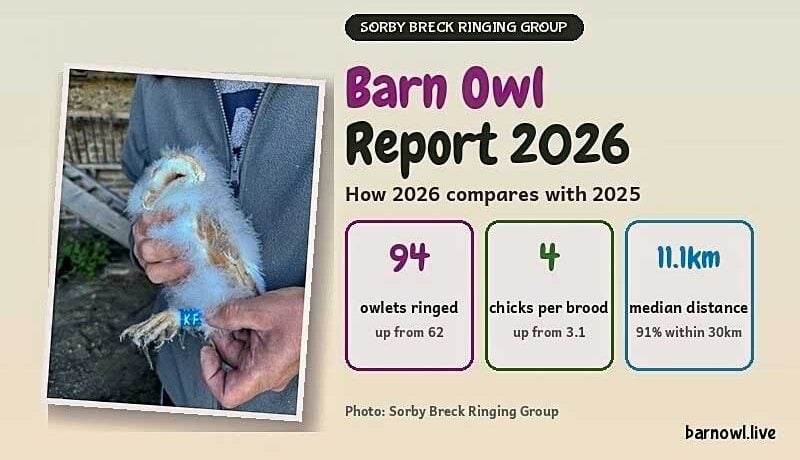

How did Derbyshire's barn owls do this year, and how does it compare with 2025?
Every year, the Sorby Breck Ringing Group puts together a report on the barn owls they've ringed, and every year I can't wait to read it. Bryn Roberts from the group has kindly sent me the 2026 report, written by Annie Adlington, and I'm delighted to be able to share it with you here. It's good news this time.
The group has now been part of the Northern England Raptor Forum's barn owl colour ringing project for three years. The aim is to find out how far young barn owls travel after they leave the nest, and how many survive. It's a big question, because around 70% of young barn owls don't make it through their first year.
2026 compared with 2025
| 2025 | 2026 | |
|---|---|---|
| Owlets colour ringed | 62 | 94 |
| Average brood size | 3.1 chicks | 4 chicks, matching the UK average |
| Recoveries | 16, of which 9 were alive | 7 so far, of which 3 were alive |
| Breeding confirmed | 2 of the live birds | 2 of the live birds |
| The weather | Early droughts and heatwaves while the owls were raising young | A dry spell, but later in the year, after most broods were raised |
| Long term average brood | 3.2 chicks, over five years | 3.3 chicks, with 2026 included |
The 2026 recoveries are only the ones reported so far. More usually come in over the autumn and winter, when barn owls are out hunting in the earlier twilight and more people see them, so I'd expect that number to grow.
A much better year
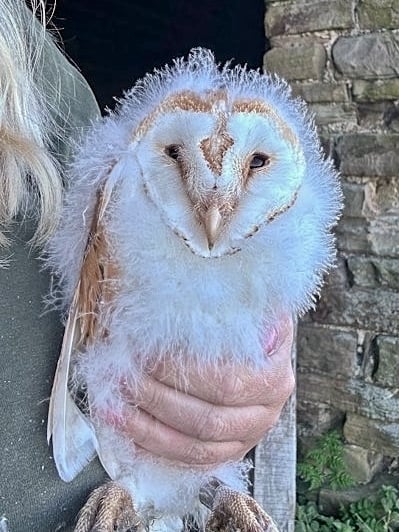
The report calls 2026 an infinitely better year than 2025, and the figures back that up. In 2025, early droughts and heatwaves hit just as the owls were trying to feed their young, and the group found owlets that had died from lack of food.
2026 had its own long dry spell, but it came later in the year. By then, most of the owls had already raised their broods, without the extra struggle of a food shortage. The result was 94 owlets colour ringed, almost double the 49 of two years ago, and an average brood of four chicks.
That fits with something the group has noticed over the years: brood sizes seem to bounce back after a poor year, as they did in 2022 and again in 2026.
Barn owls colour ringed and recovered
What the recoveries tell us
A recovery is any time a ringed bird is reported again, alive or dead. Here's how the three years compare.
| Year | Recoveries | Alive | Dead |
|---|---|---|---|
| 2024 | 5 | 0 | 5, four of them killed on roads |
| 2025 | 16 | 9 (56%) | 7: five owlets that starved, one taken by a predator and one road casualty |
| 2026, so far | 7 | 3 (43%) | 4: one drowned in a water butt, one road casualty, two unknown |
Two of this year's three live recoveries were adults ringed the year before, and both were confirmed breeding. That's exactly the kind of result the project is hoping for.
Something I was really pleased to read: in 2025, four of the live recoveries came in from video footage or photos. That's the beauty of colour rings. They're much easier to read on a camera, so the owls don't need to be caught again, and there's far less disturbance to them. It's how I've been able to identify LK and 3F at my own boxes.
How far do they go?
This year's report looks at dispersal in much more detail, using 32 recovered birds, including some ringed before 2024. Here's what stood out for me.
- Many don't go far at all. Ten of the 32 birds (31%) were recovered less than 1 km from where they were ringed. Most of these were breeding adults caught again in nest boxes.
- Most stay fairly local. The median distance was 11.1 km, and 29 of the 32 birds (91%) stayed within 30 km of home.
- They head south west. Of the 25 birds where a direction could be measured, 14 (56%) had moved south west, mostly between about 220° and 250° on the compass. That's along the Derbyshire and South Yorkshire border. A smaller group, mostly ringed in South Yorkshire, moved east and south east towards Nottinghamshire.
- And one went a very long way. Bird 7 was ringed in Derbyshire and caught again in a nest box in Powys, in mid Wales, 184.7 km away. That's more than ten times further than any other bird. Leave it out, and the average distance drops from 17.8 km to 12.4 km.
Since the report was written, Bryn tells me the group has already recorded another owl that came 54 km from Lincolnshire, and they'll be updating the figures in December.
The furthest travellers
The eight longest movements out of 32 recovered birds. Most of the rest stayed much closer to home.
The hazards they face
Of the 32 recovered birds, 18 (56%) were found dead, 5 (16%) were road casualties and 9 (28%) were alive at their last record. Roads are still one of the biggest dangers, but this year's report highlights another one that's easy to overlook: water.
Two of the birds drowned in water troughs, one 16.2 km from where it was ringed and the other just 30 metres away. And one of this year's recoveries drowned in a water butt.
Brood sizes
According to the Barn Owl Trust, barn owls in the UK raise an average of four chicks per brood. Of the broods the group has ringed in recent years, only 2022 and 2026 met that average. Across all their years of data, Derbyshire's barn owls have averaged 3.3 chicks per brood.
Average brood size, Derbyshire
What it means for my own owls
Reading this report alongside what I see on my cameras is fascinating. Buster, Mia and LK all settled just a few kilometres from where they hatched, which fits nicely with the third of birds that stayed close to home.
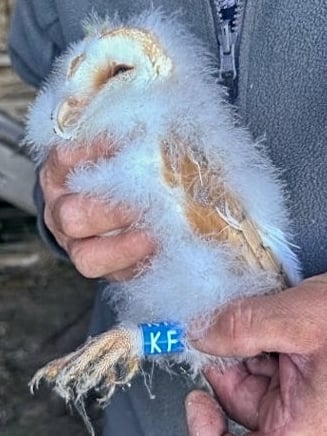
3F, the young owl that turned up on my night camera this year, is one of 2026's colour ringed owlets. I could read the letters on the infrared camera but not the colour, and the group has now confirmed that 3F wears an orange ring. You can read all about my ringed owls in my article on barn owl ringing in the UK.
Have you spotted a colour ringed owl?
The group would love to hear from you. Barn owls in the project wear either a blue ring with white letters or an orange ring with black letters on their left leg. And this year, the Northern England Raptor Forum has started colour ringing kestrels too, with black rings and white letters or numbers, so keep an eye out for those as well.
If you see one, note the ring colour, the letters, which leg it's on, the date and the place, and take a photo if you can. Then report it to the BTO.
Questions people ask
How far do young barn owls travel in Derbyshire? In the Sorby Breck Ringing Group's data, the median distance was 11.1 km, and 29 of 32 birds stayed within 30 km of where they were ringed. Most moved south west, and one exceptional bird travelled 184.7 km to mid Wales.
How many barn owls were colour ringed in 2026? The Sorby Breck Ringing Group colour ringed 94 barn owl owlets in 2026, up from 62 in 2025 and 49 in 2024.
Why was 2026 a better year for barn owls than 2025? In 2025, early droughts and heatwaves left owls short of food while they were raising their young. In 2026 the dry weather came later in the year, after most broods had been raised.
What does a colour ringed barn owl look like? Barn owls in this project wear a blue ring with white letters or an orange ring with black letters on the left leg, as well as a metal ring. Kestrels now have black rings with white letters.
What should I do if I see a colour ringed barn owl? Note the ring colour, the letters, which leg it is on, the date and the place, take a photo if you can, and report it to the BTO.
Thank you
A huge thank you to Annie Adlington, who wrote the report, and to Bryn Roberts and everyone in the Sorby Breck Ringing Group, who give up so much of their own time to do this. The group also thanks the Sheffield Bird Study Group and the Derbyshire Ornithological Society for their contributions to the project.
If you'd like to compare with last year in more detail, you can still read the Sorby Breck Barn Owl Report 2025.
Paul 🦉