
Search online for what barn owls eat and you'll find lots of different answers, often with very precise percentages. The truth is simpler: a barn owl eats whatever small prey is easiest to catch where it lives. Barn owls are very good at adapting.
When there are plenty of field voles about, they eat mainly voles. When it's a poor year for voles, they quickly switch to other prey, such as shrews, mice, young rats and even small birds. So please treat the figures on this page as exactly what they are: a guide, not a rule.
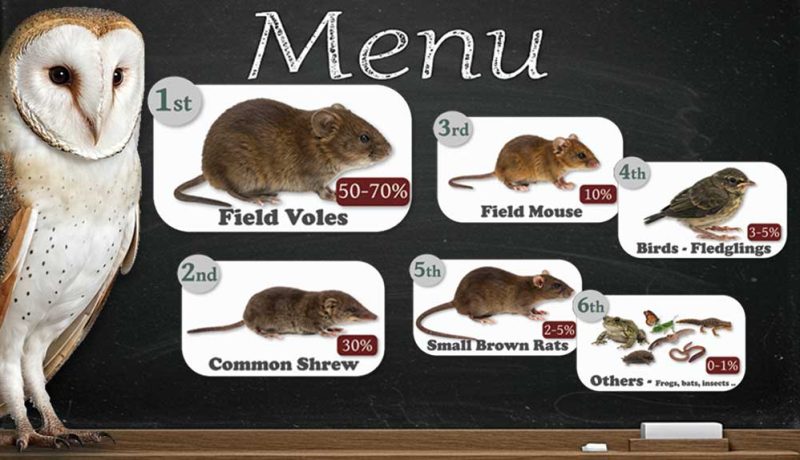
🐭 A typical UK barn owl diet (a rough guide)
These figures are based on my own observations from watching barn owls here in the Peak District. They're a good starting point, but they won't add up neatly to 100%, because the mix changes all the time. As you'll see further down, it varies a lot from place to place and year to year.
The barn owl's menu at a glance
Birds and rats mostly when raising owlets. Frogs, bats and insects only occasionally, when food is short.
| Prey | How much of the diet | Notes |
|---|---|---|
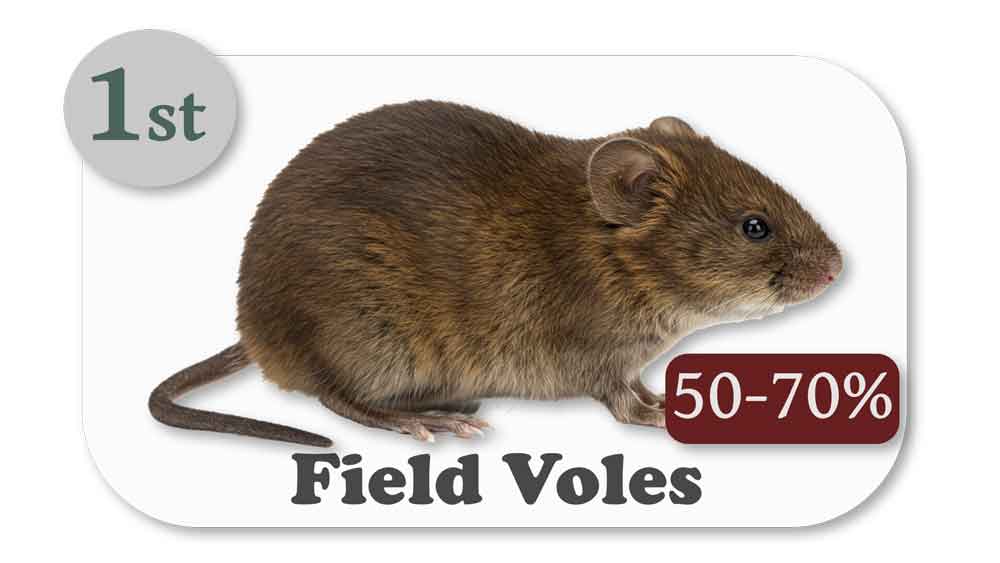
| 🐭 Field voles | 50 to 70% | The main prey. They live in rough, tussocky grassland, the barn owl's favourite hunting ground |
| 🐁 Shrews | Up to 30% | Many predators dislike the taste of shrews, but barn owls happily eat them |
| 🐭 Mice | Around 10% | Become more important when voles are scarce |
| 🐦 Small birds, mainly fledglings | 3 to 5%, when raising owlets | More likely when owls have hungry owlets to feed |
| 🐀 Small brown rats | 2 to 5%, when raising owlets | Much bigger than a vole, so one rat is a big meal |
| 🐸 Other | Occasionally, when food is short | Frogs, bats and the odd insect |
Why the numbers never quite agree: most studies count prey by number, so a tiny shrew counts the same as a large rat. Counted by weight, shrews matter much less and rats much more. That's one reason you'll see such different figures online.
🌍 It all depends on where the owl lives
This is the most important thing to understand about a barn owl's diet. Here are a few real examples of how much it changes:
- A typical UK average, as published by the Barn Owl Trust, is roughly 45% field voles, 20% common shrews and 15% wood mice.
- In North Sutherland, in the far north of Scotland, a local study found far fewer voles and many more shrews: about 26% field voles, 43% common shrews, 24% pygmy shrews and only 5% wood mice.
- In Ireland, there are no field voles or common shrews, so barn owls there rely much more on mice.
Same species of owl, very different menus. They simply catch what's there.
Good vole years and bad vole years
Field vole numbers go up and down in a cycle, usually peaking every three or four years. In a good vole year, barn owls eat mostly voles, lay more eggs and raise bigger broods. When vole numbers crash, the owls switch to shrews, mice, young rats and birds, and they often raise fewer chicks, or don't breed at all.
In my experience: when there's an abundance of field voles, that's mainly what barn owls eat. When times are hard on the vole front, they quickly adapt to other prey, like small rats and birds. Plain and simple, they adapt.
🍽️ How a barn owl eats its prey
Barn owls usually swallow small prey whole, and almost always head first. It's the most efficient way to do it: the fur lies in the right direction, so the vole slides down smoothly, and its legs fold neatly backwards instead of catching in the owl's throat. The owl uses a rocking movement of its head and contractions of its throat to swallow it quickly, until finally the tail disappears.
Larger prey, such as a young rat, may be torn into pieces with the beak first, especially when it's being fed to owlets.
💧 Food is drink too
Barn owls get most of the water they need from their food. Small mammals are juicy compared with something like an insect, so a vole isn't just a meal, it's also a drink. That's why you'll rarely see a barn owl drinking, although they do sometimes drink and bathe, especially in hot weather.
🦴 Pellets
A barn owl can't digest fur and bones, so a few hours after eating it coughs them up as a dark pellet. Each pellet usually holds the remains of a few small mammals. Scientists and schoolchildren take pellets apart to see exactly what the owl has eaten, and it's how most of the figures on this page were worked out.
Now and then, pellets contain insect remains. These have probably been eaten by accident, inside the stomach of another animal the owl caught, rather than hunted on purpose.
🌙 When do barn owls hunt?
Barn owls mostly hunt from dusk and through the night, but they're more flexible than many people think. You'll often see them out in the early evening and at dawn, and they'll hunt in daylight when they need to, especially in winter, after a spell of bad weather has stopped them hunting at night, or when they have hungry owlets to feed.
Heavy rain, strong wind and deep snow make hunting very hard, because barn owls rely on hearing their prey and their feathers aren't waterproof. A few nights of bad weather can leave them seriously short of food.
🐣 Feeding the owlets
An adult barn owl typically eats three or four prey items a night, and during the breeding season a pair tries to find about the same again for every owlet. With four hungry owlets, that can mean 15 or 20 deliveries a night on top of the parents' own meals. Across a whole year, a pair and their young can get through close to 4,000 prey items.
With that much to find, almost anything suitable goes on the menu. This is when you're most likely to see a barn owl bring in a small bird, a young rat or even a frog. It might seem harsh, but it's simply nature, and it's how the owlets get enough to grow.
Watch it for yourself: one of the best ways to see what barn owls really eat is to watch a nest camera in the breeding season and count the deliveries. You can do exactly that on our live barn owl camera.
🎬 Watch: Poppy and Oscar explain
Prefer to watch? In this short, fun video for all ages, our cartoon barn owls Poppy and Oscar talk it through.
More about the video, and the free fact sheet that goes with it: Poppy and Oscar's Barn Owl Menu.
🌾 How to help barn owls find food
- Let grass grow long. Rough, tussocky grass that isn't mown or grazed hard is where field voles, shrews and mice thrive, and the owls follow.
- Leave wild field margins and strips of rough grass along hedges, ditches and fences.
- Provide somewhere to nest and roost nearby. Here are my barn owl nest box sizes and checklist.
⚠️ Be careful with rat poison. Barn owls that eat poisoned rats and mice can be poisoned themselves. If you need to control rats, use traps, or follow the product's safety guidance carefully and never leave poison where wildlife can reach it.
❓ Questions people ask
What is a barn owl's favourite food?
In the UK, it's the field vole. Voles usually make up the biggest part of the diet, although barn owls quickly switch to shrews, mice and other prey when voles are scarce.
How much does a barn owl eat a night?
An adult typically eats three or four small mammals a night. When they have owlets, a pair needs to find about the same again for each chick.
Do barn owls eat birds?
Sometimes, but birds are usually only a small part of the diet. They're most likely to be taken when owls are struggling to find enough voles or have hungry owlets to feed.
Do barn owls eat rats?
Yes, mainly young brown rats. They're only a small part of the diet by number, but each one is a big meal.
Do barn owls drink water?
Only occasionally. They get most of the water they need from the animals they eat.
Why do different websites give different barn owl diet figures?
Because a barn owl's diet really does change depending on where it lives, what prey is around and whether it's a good or bad vole year. Treat any figures as a rough guide.
📚 More from Barn Owl Live
- 📄 Barn owl fact sheets to download, including a PDF version of this article
- 🎥 Watch our live barn owl and wildlife cameras on YouTube
- 🦉 How barn owls hunt
- 📖 More barn owl information from Barn Owl Live
- 🎧 Talking Wildlife podcasts
- 📷 Wildlife photography on Instagram @PeakyWildlife
- 🖥️ Free barn owl and wildlife screensavers
Paul 🦉
Please share this article if you like it!