
UK Red and Amber List Birds and Endangered Wildlife

Which of Britain's birds and animals are in trouble, and which are doing well? This page lists every bird on the UK's Red, Amber and Green lists of conservation concern, explains what the lists mean, and shows which of our mammals are threatened with extinction. You'll also find out how our own owls are doing, and what you can do to help.
Source: Birds of Conservation Concern 5 (2021), including the 2024 update for breeding seabirds. The next full review is expected in 2027.
What do the Red, Amber and Green lists mean?
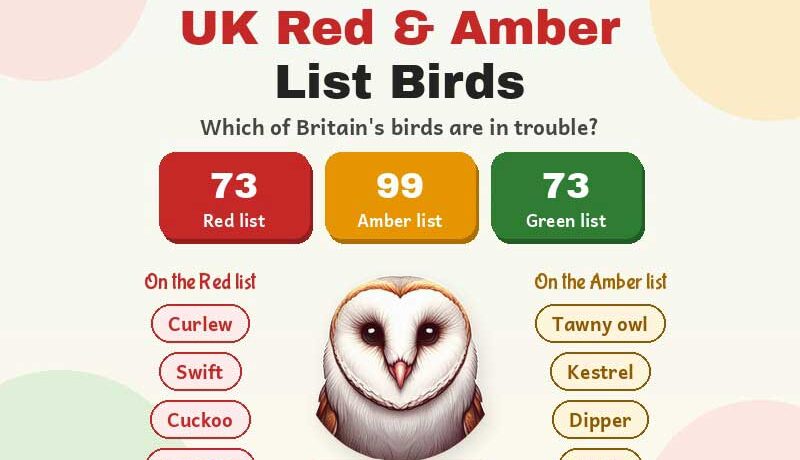
Every few years, the UK's leading bird organisations, including the RSPB, BTO and the government's nature agencies, review all 245 of the UK's regularly occurring birds in a report called Birds of Conservation Concern. Each species is placed on one of three lists, like a traffic light:
The first Red list, in 1996, had 36 species. Today it has 73, more than ever before, and for the first time it's as long as the Green list.
How are our owls doing?
You can watch our barn owls and tawny owls on the live wildlife cameras.
Find a bird
⛰️ = a bird you might see in and around the Peak District. 🆕 = added to the Red list in 2021 or 2024.
🔴 The Red list: 73 species
🟠 The Amber list: 99 species
🟢 The Green list: 73 species
The good news! These birds aren't currently of conservation concern. They include many familiar garden birds, like the robin, blue tit and blackbird, plus conservation success stories such as the red kite, buzzard and, of course, the barn owl.
What changed in the latest reviews?
- New to the Red list in 2021: swift, house martin, greenfinch, Bewick's swan, ptarmigan, purple sandpiper, Montagu's harrier, goldeneye, smew, dunlin and Leach's storm-petrel.
- New to the Red list in 2024 (the seabird update): common gull, great black-backed gull, Arctic tern, and great skua, which was badly hit by bird flu.
- Good news: the white-tailed eagle moved from Red to Amber thanks to reintroductions, and song thrush, pied flycatcher, grey wagtail, redwing, black redstart and shag also moved from Red to Amber. Red grouse, mute swan and kingfisher moved from Amber to Green in 2021, and the black guillemot followed in 2024.
- Lost: the golden oriole no longer breeds in the UK.
Britain's threatened mammals
In 2020, the Mammal Society published the first official Red List for British mammals. It found that 11 of Britain's 47 native mammals are at risk of extinction:
| Status | Mammals |
|---|---|
| 🔴 Critically Endangered | Wildcat, greater mouse-eared bat |
| 🔴 Endangered | Beaver, red squirrel, water vole, grey long-eared bat |
| 🟠 Vulnerable | Hedgehog, hazel dormouse, Orkney vole, serotine bat, barbastelle bat |
A further five species, including the mountain hare, are classed as Near Threatened. You can see mountain hares in the Peak District, where they turn white in winter.
Why are so many species declining?
- Loss of habitat, especially meadows, rough grassland, hedgerows and wetlands. Around 97% of species-rich grassland has been lost since the 1930s.
- Changes in farming, leaving fewer insects, seeds and safe nesting places.
- Climate change, which is altering when food is available and where species can live.
- Problems on migration, as many Red-listed birds, like swifts, cuckoos and turtle doves, spend the winter in Africa.
- Disease, such as bird flu, which has hit seabirds hard since 2021.
How you can help
- 🐦 Put up nest boxes, including swift boxes and house martin cups, and leave spaces under the eaves.
- 🌼 Leave a wild corner with long grass, wild flowers and log piles for insects, voles and hedgehogs.
- 🦔 Make a hedgehog highway with a 13cm gap in your garden fence.
- 🚫 Avoid pesticides and rat poison, which harm owls, birds of prey and other wildlife.
- 📋 Record what you see through schemes like the RSPB's Big Garden Birdwatch or the BTO's BirdTrack. Your sightings help scientists track how species are doing.
🦉 Learn more: test what you know with our free wildlife quiz, or download our free wildlife worksheets for schools.
Questions people ask
What is the UK Red List for birds?
It's the Red list from Birds of Conservation Concern, a review of all the UK's regularly occurring birds by the country's leading bird organisations. Species go on the Red list if they're globally threatened, have declined severely in number or range, or have suffered a big historical decline.
How many UK birds are on the Red list?
73 species are currently on the Red list, 99 on the Amber list and 73 on the Green list, following the 2024 update for seabirds.
Which birds are on the Green list?
73 species are on the Green list, including familiar birds like the robin, blackbird, blue tit, great tit, goldfinch and swallow, birds of prey such as the buzzard, red kite and peregrine, and the barn owl.
Are barn owls on the Red list?
No. Barn owls are on the Green list, the lowest level of concern, thanks in part to nest boxes and conservation work. Tawny owls and short-eared owls are on the Amber list.
Are hedgehogs endangered in the UK?
Hedgehogs are classed as Vulnerable to extinction in Britain on the Mammal Society's Red List for British Mammals, published in 2020.
When will the Red list next be updated?
The next full review of UK birds, Birds of Conservation Concern 6, is expected in 2027.
Sources: Stanbury et al. (2021) Birds of Conservation Concern 5, British Birds 114: 723 to 747; Stanbury et al. (2024) seabird addendum to BoCC5, British Birds; Mathews & Harrower (2020) IUCN-compliant Red List for Britain's Terrestrial Mammals, The Mammal Society.
Paul 🦉
Please share this article if you like it!