


A Short Guide to Barn Owls: All You Need to Know
Everything about Britain's silent night hunter, from how it flies to how it raises a family
If you drive along a country lane at night and see an almost white, large bird flying low to the ground in your headlights, it is very likely a Barn Owl. Few other birds look so pale when their underside catches the light, and it is why so many people remember their first sighting for the rest of their lives.
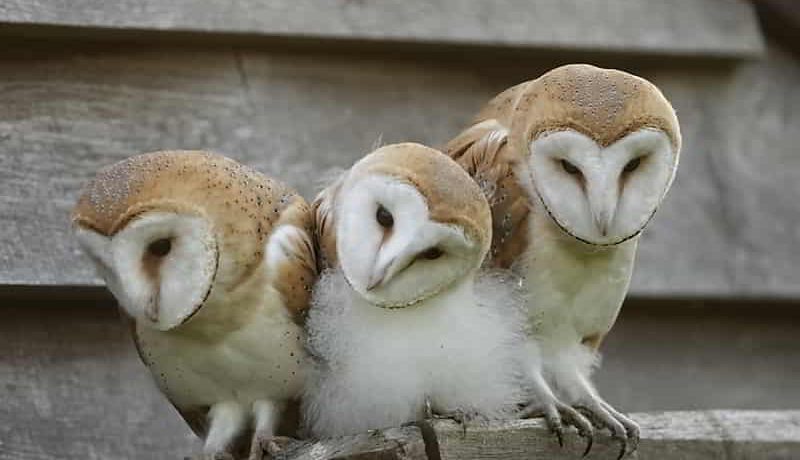
The Barn Owl is one of the most attractive of all owls. It has a soft, heart shaped face, dark eyes like drops of ink, and a back that mixes golden buff, grey and white, which is very good camouflage in the grassy places where it lives. It hunts at dusk and through the night, flies without a sound and raises its family in barns, old buildings, hollow trees and nest boxes, which is where its name comes from.
This guide covers everything you need to know. It is written mainly about the Barn Owls of the UK, because that is where I watch them, at my nest boxes in the Peak District, and where most of my readers live. Where a Barn Owl elsewhere in the world does something different, I say so. If you want more detail on a topic, I have linked to my longer articles as we go.
What is in a name?
The Barn Owl's scientific name is Tyto alba. It was given in 1769 by an Italian doctor and naturalist called Giovanni Scopoli. Alba is the Latin word for white, and Tyto comes from an old Greek word for an owl, one that is thought to copy the sound the birds make. So the name simply means white owl, and it describes the bird beautifully.
Barn Owls belong to the family Tytonidae, while our Tawny Owl and most other owls belong to a different family, the Strigidae. You can tell the two apart in several ways. A Barn Owl has a flat, heart shaped face, small dark eyes and long legs, while a Tawny has a rounder face and bigger eyes. The Barn Owl's middle claw has a tiny row of teeth on the inner edge, like a comb, which it uses to tidy the feathers around its face. And Barn Owls do not hoot. They screech. A hoot is a Tawny Owl sound.
Silent flight
Watching a Barn Owl fly over open fields is mesmerising. It flies in total silence, and the reason is the design of its feathers. The front edge of each main wing feather is shaped like a little comb, the back edge has a soft fringe, and the upper surface has a velvety layer of tiny hair like structures. Together they smooth the air over the wing and cut down the noise. Even the legs and feet carry very fine feathers to reduce turbulence.
The wings are also huge for the size of the bird. Engineers call this a low wing loading, and it means the owl can fly very slowly without stalling, at little more than walking pace, or even hang in the air on a slight breeze. That slow, quiet flight gives the owl time to listen for its prey, and it means the prey cannot hear the owl coming.
There is a price to pay. Barn Owl feathers are not very waterproof. In a heavy shower an owl can gain around a quarter of its body weight in water, and a bird that is completely soaked can end up over three quarters heavier. A wet owl cannot fly properly, and it certainly cannot fly quietly, which is why Barn Owls avoid hunting in the rain and why a run of wet weather is such a danger to them. They also carry very little body fat, so they cannot sit out a long spell of bad weather on their reserves.
What a Barn Owl looks like
Barn Owls are medium sized birds, a little over a foot long, with a wingspan of around 80 to 95 centimetres, or roughly 31 to 37 inches. They look bigger than they are, because the soft plumage makes them seem chunky when they sit, and the long wings make them look enormous in flight. In reality they are very light, usually around the weight of a small bag of sugar. When they are relaxed and roosting, they sink down into their feathers and can look even smaller.
The upper side is a lovely mixture of golden buff, soft grey and white, with a scattering of tiny dark and pale flecks on each feather. The underside is white or pale buff, often with a few dark spots. The face is white with a patch of reddish brown in the corner of each eye and a rim of stiff feathers around the edge. The eyes are so dark they look black, and the bill is pale. The legs are long and covered in short white feathers, and the toes can be anything from dull grey brown to a bright yellow.
There is a lot of variation between individuals. Some birds are almost pure white, while others are a rich, deep buff. Lightly marked males can look completely white as they fly over you at night, and darker females can look surprisingly like a Short eared Owl from a distance. Most British birds are the pale, white breasted type, and now and then a darker, orange breasted visitor from the continent turns up in eastern England.
Male or female?
It is not always easy to tell male and female Barn Owls apart, and no single clue is enough. The best approach is to add several clues together and see where most of them point.
- Size and weight. Females are around a fifth heavier, at about 360 g against 300 g for a male, though it is hard to judge unless the pair stand side by side.
- A darker facial rim. A female often has a slightly darker brown edge to her face.
- A buff throat. The female's throat is often buff coloured, where the male's is whiter. It shows best in natural daylight.
- Spots. Females tend to have small flecks down the flanks and sometimes across the chest, while males are usually plainer white.
- Overall colour. Females are usually a little darker and richer, and tend to have slightly darker tail feathers.
- Behaviour. In courtship, the female often does more of the preening, and once the eggs are down, the bird on the nest is the female.
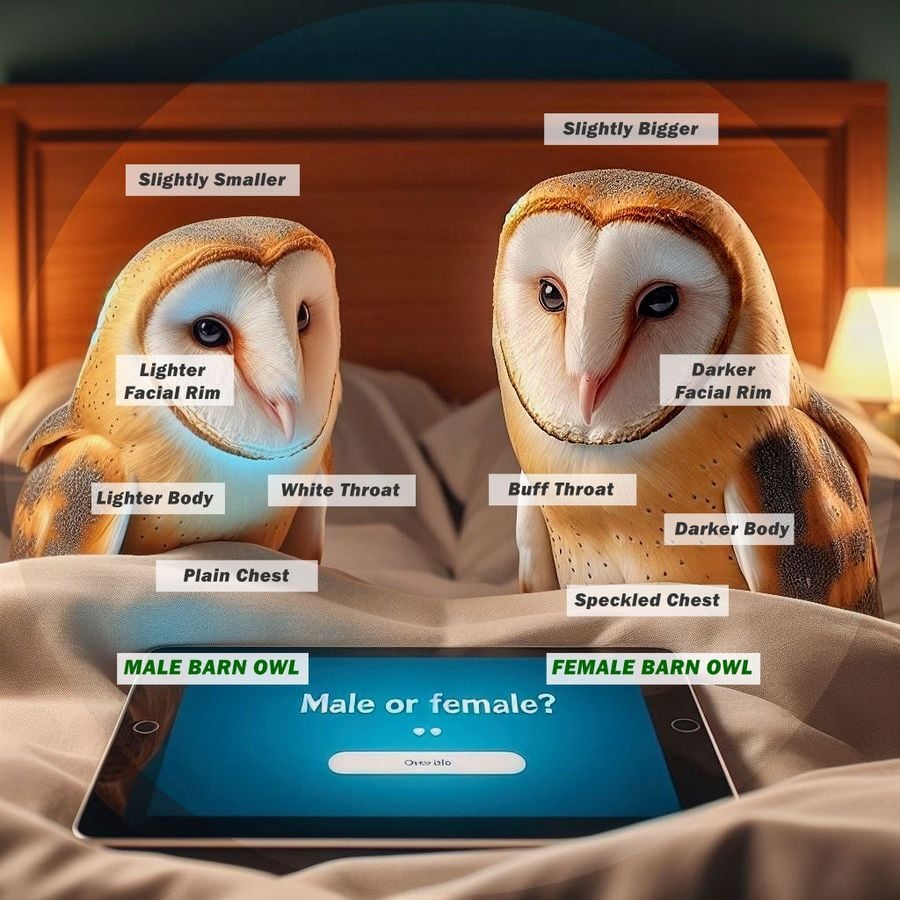
I once watched two females that had almost no spots on their chests, but they had a few flecks on their flanks, a buff throat and a slightly darker look. Both spent a lot of time fussing over a smaller male, and when eggs turned up in the nest box, that settled it. For more detail, read my full guide, How to tell the sex of a Barn Owl.
Built for the night
A Barn Owl is one of the most finely tuned night hunters on the planet, and nearly every part of it seems designed for the job. Here are the main tools of the trade.
Ears like a satellite dish. The heart shaped face is a sound collector. Stiff, curved feathers around the edge of the disc scoop up noise and funnel it to the ear openings just behind the eyes. The two ears sit at different heights, so a sound reaches each one slightly differently, and the owl's brain uses the difference to work out exactly where the sound came from, both left and right and up and down. A Barn Owl can locate a sound more accurately than any other animal that scientists have tested, and it can catch prey in complete darkness using its hearing alone.
Eyes for dim light. Barn Owl eyes are large, dark and shaped more like tubes than balls, with wide pupils and lots of light sensitive cells. In low light they see better than we do, but they cannot see in total darkness, and on very dark, cloudy nights they lean heavily on their ears. The eyes are fixed in their sockets, so the owl cannot roll them. Instead, it moves its whole head. That is why you see a watching Barn Owl bobbing and swaying its head from side to side. Each little movement gives it a slightly different view, and by comparing them it can judge how far away its prey is.
A neck that turns and feet that grip. An owl can twist its head around by about 270 degrees, three quarters of a full turn, so it can look straight behind itself. Its feet are strong, with sharp curved talons, and the outer toe can swing backwards or forwards to change the grip.
Barn Owls seem to pay little attention to anything that stays still. If you stand quietly, a bird may ignore you completely, and there are plenty of stories of an owl landing on a gatepost next to a motionless person. As soon as you move, it notices and is gone.
Where Barn Owls live
Barn Owls are birds of open country. They hunt over rough, tussocky grassland, field margins, hedgerows, ditches, riverbanks and marshes, and they roost and nest in barns, old buildings, hollow trees and nest boxes. They like to nest with a view over the rough grass where they hunt, and they look for an entrance sheltered from the prevailing wind and rain. On my own land, boxes facing northwest have worked best, though in other places northeast is often recommended. A mown garden will not suit a Barn Owl, but a large, quiet garden that borders rough grassland might.
Many people think a Barn Owl guards a patch of land, but it is a much more relaxed neighbour. Barn Owls do not defend territories. Their home ranges are large and overlap a great deal. During the nesting season, most hunting happens within a kilometre or two of the nest, and in winter owls may travel three or four kilometres, and sometimes further, to hunt. The nest is rarely in the middle of the range.
Once an adult settles, it usually stays. Barn Owls are homebodies that do not migrate, and they will often use the same nest and roost sites for life. That familiarity pays off. A bird that knows exactly where the voles are and which routes are safe on a dark, foggy night uses far less energy than one that starts again in strange country.
Roosting and daily life
The Barn Owl is a nocturnal bird. It rests out of sight during the day, which is why you seldom see one in daylight, and it comes out around dusk. It will roost in trees, but it much prefers the safety of a nest box, an old building or a high, dry ledge that offers shelter, privacy and protection. Most roosts are at least three metres off the ground.
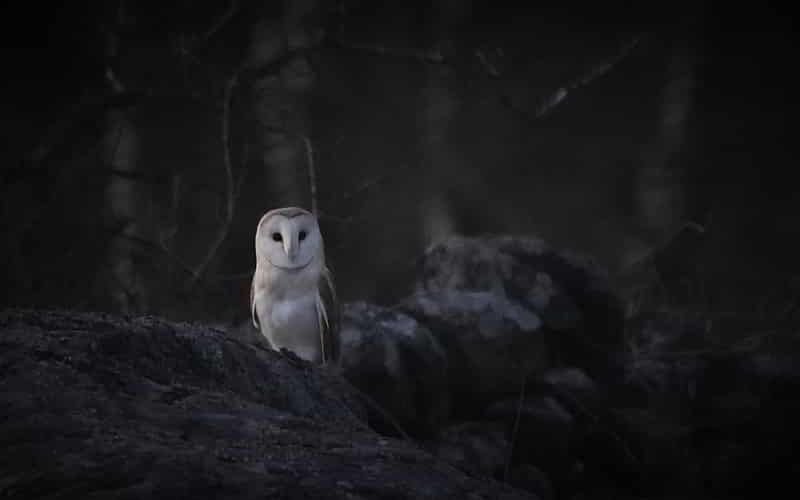
A resting owl stands on one leg with its eyes closed. If it senses danger, it stands tall, pulls its wings in tight and narrows its eyes to slits, and it can be surprisingly hard to spot. Pairs often roost apart from each other for much of the year and only come together as the breeding season nears. In my nest boxes, the male often sits on an upper roosting ledge during the day while the female and owlets are in the nest below. For more, see my article Barn Owl Roosting.
A Barn Owl's year
Barn Owls do not migrate or hibernate, so the birds you see in January are usually the same ones you see in July. What changes through the year is what they are trying to do.
Winter is the hardest season. Prey is scarcer and less active, the nights are long and cold, and rain and snow make hunting difficult. A cold owl needs more food, not less, so many birds hunt in the afternoon and use fence posts as lookouts to save energy, and they range further from home than they do in summer. It is when many adults and young birds die, most often in January and February.
In late winter and spring, pairs begin to roost together, males start bringing food gifts and females put on weight. Eggs are usually laid in April or May, and nesting has been recorded in every month of the year. Over recent decades, Barn Owls in Britain have been laying earlier, probably because springs are warmer. Summer is the busiest time. The female sits on the eggs, the owlets hatch and grow, and the male hunts almost nonstop, sometimes in broad daylight. In autumn, the young disperse and many die in the first few weeks, while the survivors settle by the end of November and the adults finish their moult. From the first courtship to a fully independent youngest owlet takes at least four and a half months, which is longer than for most birds of a similar size.
How a Barn Owl hunts
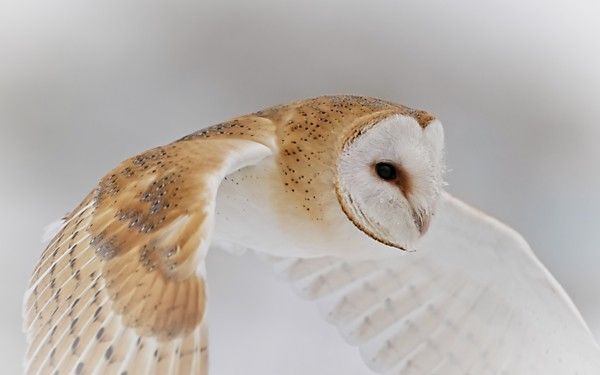
Barn Owls hunt mainly on the wing. They glide silently over rough grassland at around one to three metres, zig zagging across the field with almost sat nav precision, looking and listening for the tiny sounds of small mammals. This slow, methodical search is called quartering, and a patch may need several passes before the owl detects anything. When it hears something promising, it often stops and hovers with its head perfectly still, its face pointed at the sound, and then it drops, feet first, with its talons stretched out.
Between flights, a Barn Owl will sometimes perch on a fence post, a wall or a low branch and watch for movement. In cold weather especially, this sit and wait method saves energy, because flying loses heat and a Barn Owl carries very little fat. When it sees or hears movement, it moves its head from side to side to judge the distance, then swoops in.
Barn Owls come out at dusk and hunt through the night, and again just before dawn. But they are not strictly nocturnal. If the weather has been bad, if it is deep winter or if there are hungry owlets to feed, they may hunt in daylight. A Barn Owl hunting in the afternoon is not always a sick one. It may simply be a hungry one. On the other hand, they avoid hunting in rain, because wet feathers make them heavy and noisy and the sound of rain masks the noises they listen for.
A Barn Owl kills with its feet, gripping the prey and squeezing harder each time it moves, and a young owl seems to know how to do this by instinct. Then it swallows the catch whole, head first, so that the fur lies in the right direction and the legs fold back. The owl rocks its head, its throat works in rhythmic contractions and the tail slowly disappears. For more, read my article Barn Owl Hunting.
What Barn Owls eat
The Barn Owl's favourite food is the field vole. Thousands of pellets from all over Britain have been collected and picked apart, and the results are clear. Nearly half of all the prey items were field voles, about a fifth were common shrews, and about one in seven were wood mice. Between them those three account for around four out of every five meals. The rest is made up of pygmy shrews, bank voles, harvest mice, and small numbers of house mice, brown rats, small birds and frogs.
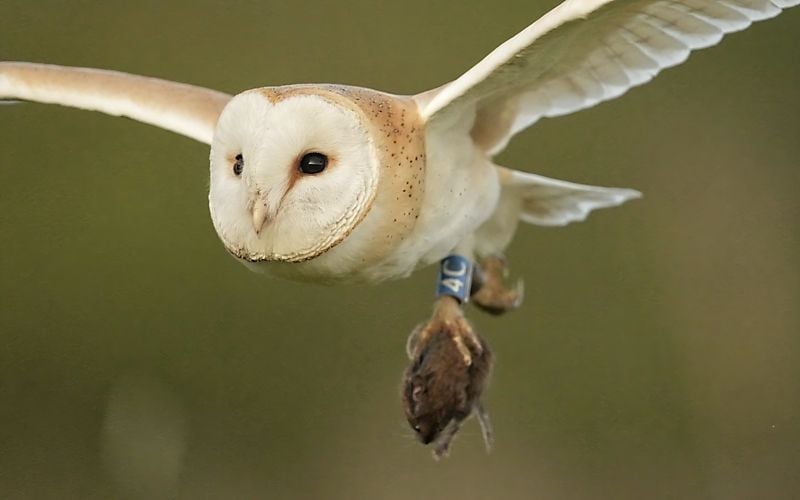
A field vole is just about the perfect meal. It weighs 20 to 30 grams, so it gives the owl around a third of its daily needs, and it is small enough to swallow whole, easy to carry to the nest and simple to tear up for newly hatched chicks. A Barn Owl in winter eats about 75 grams of food a day, roughly three field voles. Because it gets its water from its food, a juicy vole is a meal and a drink in one.
In some places and at some times, the menu changes. On my nest cameras, when the owlets are growing, small fledgling birds turn up at about three to five per cent of deliveries and young brown rats at about two to five per cent, with the odd frog on very hungry nights. When voles are scarce, owls take more shrews and mice. Bats, on the other hand, are almost never on the menu, however often people say otherwise. In the big national pellet survey, only about three in every ten thousand prey items were bats.
If you want to encourage Barn Owls, let the grass grow long and leave field edges unmown. Voles, shrews and mice love long, undisturbed grass, and where the rodents go, the owls follow. My article What do Barn Owls eat? has the full story.
Pellets
Swallowing prey whole means the owl also swallows fur and bones it cannot digest. The gizzard, a muscular part of the stomach, squeezes them into a tidy lump called a pellet, which the owl coughs up, usually once a day. Barn Owl pellets are easy to recognise. They are black, smooth and glossy when fresh, and stay dark and fairly hard as they dry, and they are usually four to six centimetres long, with flecks of white and grey where bone and fur show through.
Pellets are one of the best ways to find a roost, because a pile of pellets and white droppings under a perch or beam is a sure sign of an owl. They are also used as nest bedding. Before she lays, the female often moves the pellets around, breaks them into smaller pieces and scatters them across the nest floor with her talons, and the soft, furry mix makes a warm, dry bed. If you pull a pellet apart, you will find skulls and jaw bones that show exactly what the owl has been eating. Wear gloves for fresh ones and wash your hands afterwards.
The voice of a Barn Owl
A Barn Owl's most famous sound is the screech, a long, drawn out, shivery scream that lasts about two seconds and is usually given in flight. It works as a song. It announces that a bird is around, invites an unpaired female to come along, and keeps a pair in touch. Between a pair, you will also hear gentler sounds, including purring, twittering and squeaking. Females and owlets make a rough, wheezy sound called snoring, which is not a request for food so much as a way of saying I am here, although it gets louder when they are hungry.
When a Barn Owl is frightened, it hisses fiercely, sways its head from side to side, spreads its wings and fluffs itself up to look as big as it can, and it may click its tongue. If it is cornered, it can strike upwards with its talons very fast. Wild Barn Owls are protected, so if you ever see one in that state, back away quietly.
Courtship: monogamous, usually
Barn Owls are known for mating for life, and most pairs stay together for as long as both birds survive. But I have also seen a new female arrive in a territory and force a bonded female out to secure her mate. As Barn Owls tend to stay in areas they know and trust, the male simply bonded with the newcomer.
Courtship is all about food and touch. In late winter, the pair start roosting close together and spend hours preening each other and chattering softly. The female usually does more of the grooming, and the male ends up rather henpecked, which is one of the earliest visual clues to which bird is which. The male becomes the main provider, bringing voles to the female as gifts, and in the last ten days before laying he may bring ten to seventeen prey items a day. Mating is frequent, particularly just after he delivers food.
When a pair looks for a nest site, they often visit possible sites together, like a couple house hunting. The female usually goes in first and looks around, while the male waits outside and only peeks in afterwards. I have seen Tawny Owls do the same. For more, see Barn Owl Mating.
Nests and eggs
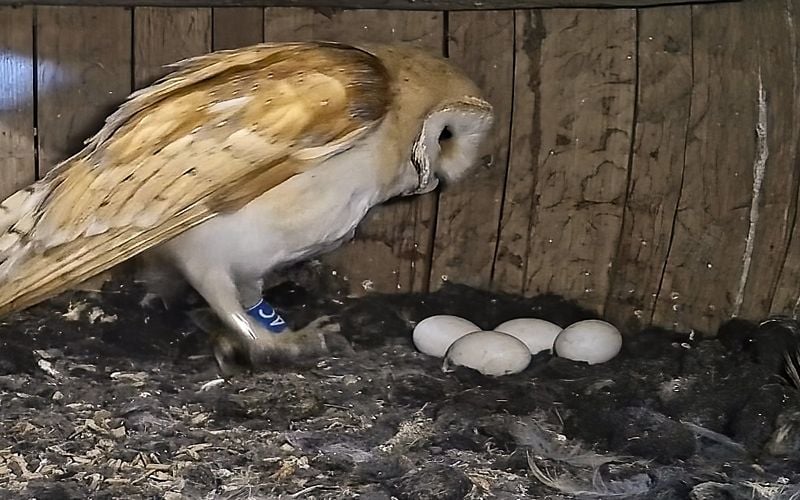
A Barn Owl does not build a nest. It lays its eggs straight onto whatever is already there, which is often old pellet debris, straw or hay. Barn Owls like to nest in barns and other buildings, and they will use hollow trees, but they like a roomy nest and so tend to look for a suitable building or a nest box.
Most eggs are laid in April or May, though the timing varies with the food supply and the weather. The female lays four to six white eggs, two to three days apart. Unlike many birds, she starts sitting on them as soon as the first egg is laid, so they hatch in the order they were laid, one every two to three days. She does all of the incubating, which takes about 30 to 32 days.
During this time, the male does all the hunting for both of them. He may bring the female a vole or a mouse before the eggs are even laid, to show her he is a good provider, and he leaves food at the nest for her to eat. Because the female sits for a month and the owlets stay in the nest for more than eight weeks, the male can be the only food provider for over two months. Some eggs do not hatch, and out of four eggs it is quite common for three to hatch. On average, about three quarters do.
Growing up: from egg to owl
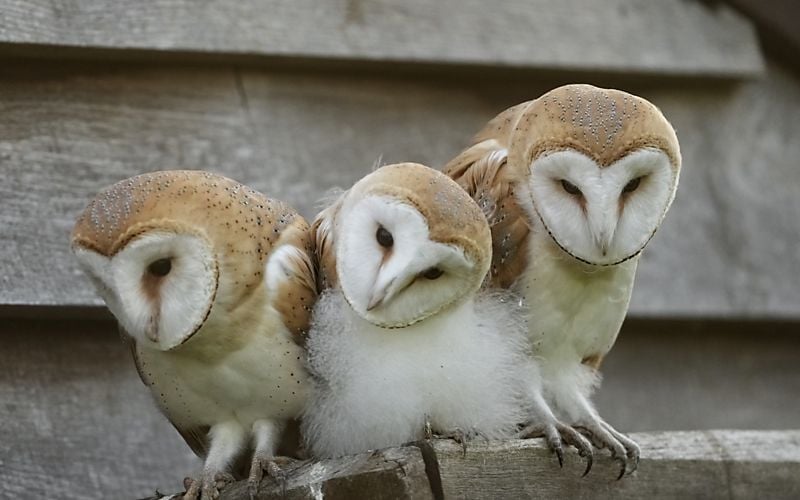
Around 30 days after the first egg was laid, the first owlet is ready to hatch. It has a tiny hard bump on the tip of its bill, called an egg tooth, which it uses to break through the inner membrane and then chip through the shell, a process called pipping. The female often helps by nudging aside pieces of cracked shell. When it emerges, the owlet is almost bald and pink, but within a day it is covered in white down. The female tears up a small mammal left by the male and feeds tiny strips to the newborn. Being first to hatch and be fed gives that owlet a head start on its brothers and sisters.
Every two to three days another egg hatches, and the female keeps them warm while the male hunts. It can take as little as a week before a chick tries to swallow a small rodent, and by two or three weeks they can swallow whole shrews and mice. The owlets that are fed most are the ones most likely to grow and fledge, and in poor years the youngest may not survive.
At around three weeks, a thicker second coat of down grows in, and the mother no longer needs to brood them all the time. By four weeks the down is thick, white and fluffy, and it slowly turns into feathers. At around six weeks, the owlets flap their wings a lot. As far as I can tell, they do it for three reasons: to shed the last of the down, which ends up everywhere in the nest, to practise flying, even though their feathers are not ready, and to get attention and show dominance when food arrives. Over the next weeks, the flapping leads to jumping, the jumping to hops and the hops to short, messy flights.
By eight weeks, the owlets look much more like their parents, and they often sit on the ledge outside the nest at night, waiting for food to be passed from the parents' talons into theirs. Inside the nest they jump on imaginary prey, practising for the real thing. At around ten weeks, they are ready to fledge, and from then on some stay and some go, exploring the world for a place of their own. Most leave the area where they hatched between twelve and sixteen weeks old, usually in late summer and autumn, and most settle within about ten kilometres. Nobody teaches them to hunt. Their instincts kick in, and next season these young owls will start the whole cycle again.
Barn Owls around the world
The Barn Owl is the most widespread owl in the world, and one of the most widespread land birds of any kind. It lives on every continent except Antarctica. Across such a huge range, the birds differ from place to place, and experts describe many regional forms known as subspecies. Many now treat the Barn Owls of the Americas and some islands as separate species. Britain's bird is the pale, white breasted Tyto alba alba, and in eastern Europe a darker, buff breasted form, Tyto alba guttata, occasionally reaches eastern England.
The menu changes with the country. In mainland Europe, common voles, which burrow and cope with short grass and crops, are a major food, and they do not live in mainland Britain at all. In southern Europe, Barn Owls live in towns and take roosting sparrows from street trees. Irish owls have no field voles, so they rely heavily on mice, rats and shrews. In Africa, gerbils take the place of voles, and in the rice growing regions of Asia, Barn Owls are valued by farmers and encouraged with nest boxes. Scotland has the most northerly Barn Owls in the world, which is a big reason why cold, wet weather hits our birds so hard.
The Barn Owl also has some interesting relatives, from grass owls that live in tall, damp grassland to masked owls, sooty owls and the shy bay owls of tropical Asia. They all share the heart shaped face and the comb on the claw.
How long do Barn Owls live?
Life is short for most wild Barn Owls. Of all the young that leave the nest, only about one in four survives its first year. Adults do much better, with roughly two in three surviving each year, and a bird that gets through that first year can expect to live to around four years old. The oldest wild Barn Owl found through British ringing records was a little over fifteen years old. Captive owls, which are safe from hunger and traffic, can live for twenty or twenty five years, and one at an owl centre in Gloucestershire reached 34.
The main dangers are starvation, cold and wet weather, roads, poisoned rodents, drowning in deep water troughs, and falls from nests with low entrances. Deaths come in two waves. The biggest is in autumn, when the young are dispersing, and the second is in January and February, when food is short and the weather is at its worst.
A little history and folklore
For most of British history, the Barn Owl was a familiar neighbour. In the eighteenth and early nineteenth centuries, it was probably our commonest owl. Then persecution and Victorian collecting for taxidermy took a toll, and the decline sped up after the Second World War, when hedges were pulled out, old barns were converted, meadows were ploughed and farmland was sprayed with chemicals. Harsh winters in 1947 and 1963 made matters worse, and numbers hit a low in the 1970s and 1980s. Since then, thousands of nest boxes, strips of rough grass and a lot of hard work have helped the species recover.
A pale bird that glides out of the dark without a sound, screams in the night and lives in ruins was always going to attract stories. Many people took its screech as an omen of bad luck, and it earned names such as ghost owl and white owl. Others were glad to have it in the barn to keep the mice down. Today it is more often seen as a symbol of a healthy countryside.
How many are there, and are they protected?
Nobody knows exactly. In 1932 there were thought to be around 12,000 pairs in England and Wales, and then numbers fell for decades because of pesticides, the loss of hunting grounds and harsh winters. A big survey in the mid 1990s found about 4,000 pairs in the UK, and since then no equally reliable count has been done. Numbers have recovered a good deal, and in 2015 the Barn Owl was moved from the Amber list to the Green list, but they rise and fall with the vole cycle and the weather.
Barn Owls are protected by law. They are on Schedule 1 of the Wildlife and Countryside Act 1981, which means it is an offence to kill, injure or take one, to damage an active nest, or to disturb one at or near a nest with eggs or young. Only licensed people can inspect an active nest. If you want to know what is going on inside a box, use a camera that was installed outside the breeding season, or watch from a distance.
How you can help
The best thing you can do for Barn Owls is give them food. Leave a strip of rough grass, at least four to six metres wide if you can, along a field edge, hedge or ditch, and let it grow. Add a few fence posts about two metres high for the owls to hunt from, keep your hedges, and avoid using rat and mouse poison, which can pass to the owl through the rodent it eats. If you have a water trough, fit a ramp so anything that falls in can climb out, and slow down on rural roads at dusk.
A nest box is the next step, but only if you have rough grass nearby, ideally an acre or two. A good box is quiet, dry and away from busy roads, with an entrance that overlooks the grass and faces away from the prevailing wind and rain. In a tree, put it about ten to sixteen feet up, which is three to five metres. Safe design matters. Owlets are curious and clumsy, so I build my boxes like a well. The entrance hole is about 130 by 130 millimetres, and the drop from the bottom of the hole to the floor is at least 450 millimetres, so the owlets cannot tumble out. The floor should be about 0.4 square metres, and there should be a landing platform outside with a lip.
A few extra tips from my own boxes. An upper roosting ledge encourages the male to sit inside the box in the day, and a few old pellets and some dry bark chippings on the floor make a new box feel like home. I make mine from old oak whisky barrels, which are warm, dry, solid and recycled. Check inside once a year, outside the breeding season, and clear out the old debris, and be patient. A box can take months or years to be used.
Watching Barn Owls
To see a Barn Owl, go to rough grassland on a calm, dry evening about an hour before dusk, find a comfortable spot and keep still. Barn Owls tend to ignore anything that does not move. Do not use torches or recorded calls, and keep well away from any nest. Please keep the exact location of a nest to yourself, too.
If you would rather watch from the sofa, my nest box cameras stream live from the Peak District National Park, with microphones so that you can hear the owls as well as see them. You can watch on the website or on my YouTube channel, @BarnOwlLive. And if you ever find an owl that is injured, soaked or obviously in trouble, cover it gently with a towel, place it in a cardboard box in a warm, dark, quiet place, and contact a wildlife rescue or a vet. Do not try to feed it.
Quick answers
Where do Barn Owls sleep? In dry, high, quiet places such as barns, hollow trees, church towers and nest boxes, and sometimes between straw bales.
Do Barn Owls migrate? No. Most spend their whole adult life within a few kilometres of the same spot.
How many eggs do they lay, and how long do they take to hatch? Usually four to six eggs, laid two to three days apart, and each takes about 30 to 32 days to hatch.
How long do the owlets stay in the nest? Around eight to ten weeks, and they keep coming back to the nest for some time after their first flights.
Can I put a nest box in my garden? Only if it is a large garden next to plenty of rough grassland. Otherwise the owls will not find enough to eat.
Is it legal to look at a nest? Not without a licence. It is an offence to disturb Barn Owls at or near an active nest, so watch from a distance.
Why do Barn Owls sometimes hunt in daylight? Usually because food is short, the weather has been bad or there are hungry owlets to feed.
Common myths
- Barn Owls hoot. They do not. They screech, hiss and snore. A hoot means a Tawny Owl.
- Owls can see in complete darkness. They see very well in dim light, but in true darkness a Barn Owl depends on its hearing.
- Owls can turn their heads all the way round. Not quite. It is about three quarters of a full circle.
- Barn Owls eat bats. Very rarely.
- Barn Owls defend a territory. Not in the usual sense. Their home ranges are huge and overlap.
- A Barn Owl seen in daylight is ill. Not necessarily. It may be hungry, feeding chicks or making the most of a good afternoon.
- Barn Owls control rats and mice. They eat plenty, but predators tend to follow the numbers of their prey and not control them, so an owl is a lovely addition to a farm and no substitute for good pest management.
Want to know more?
There is plenty more on the website. Try The live Barn Owl nest, the Barn Owl quiz and the free downloadable fact sheets. You will find videos and podcasts on my YouTube channel, and my latest wildlife photographs, often with tips on how I took them, on Instagram at PeakyWildlife.