
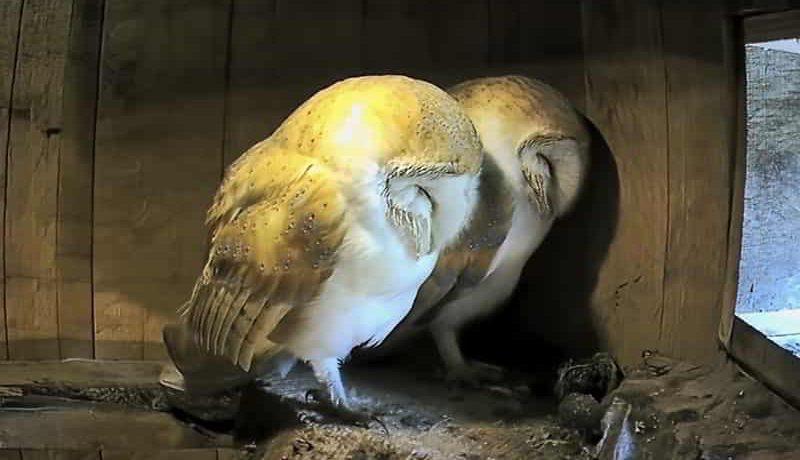

Where barn owls sleep, who they sleep with, and how to spot a roost.
A barn owl spends most of the daylight hours asleep or dozing, so where it roosts matters a great deal. A good roost is dry, quiet and safe, and barn owls are fussy about all three.
🏚️ What makes a good roost?
Barn owls choose places that are high, dry and out of the wind, with an easy way in and out that leads to open countryside. Most roosts are at least three metres off the ground.
Dry matters more than you might think. A barn owl's soft feathers aren't waterproof and soak up water, and a soaked owl can't fly properly or quietly. That's why a sheltered, dry roost is so important.
Barn owls use trees as well, particularly young birds, and particularly in dry weather. In the west of Britain most nests are in buildings, while in some parts of the east a large share are in trees. The birds simply use whatever is available.
😴 How a barn owl spends the day
Shortly before sunrise, barn owls head back to their roosts, and they usually leave again around dusk. In between, a roosting owl typically:
- stands on one leg, with the other tucked up into its belly feathers
- leans back slightly, with its eyes closed
- looks up at any small noise
- preens its feathers now and then, keeping them in perfect condition for silent flight
If it's worried, it stands tall, pulls its wings in tight against its body and narrows its eyes to slits, making itself look thin and part of the woodwork. Barn owls hide surprisingly well. It isn't unusual for someone to walk into a barn, see nothing on the beams, and later find an owl was there all the time.
Want to know why they sleep all day? Here's why barn owls are nocturnal.
💑 Do barn owls roost together?
Usually not. Outside the breeding season, most barn owls roost alone, and even a bonded pair will often sleep in different places. Each owl typically uses a handful of roost sites in its home range: one main day roost and a few others.
That changes as the breeding season gets closer:
- Before laying: the female moves into the nest site first, and the male follows. In the last ten days or so before egg-laying, the pair are usually together.
- With owlets: once the owlets are growing, the parents often roost away from the nest during the day.
- In a harsh winter: you may occasionally see barn owls sharing a roost, and a bird that has lost its own roost may join its mate at a site it knows is safe.
On our cameras: in our boxes, the male frequently roosts on the upper ledge, with the female and owlets below.
Why a second box helps: because pairs like to roost close together but not always in the same place, putting up a second box nearby as a roost can really help encourage a pair to settle. There's more about this in our barn owl nest box sizes and checklist.
🔍 Signs of a barn owl roost
- ⚪ Whitewash: white droppings splashed below a regular perch.
- ⚫ Pellets: fresh pellets are black and glossy. A pile of them on a ledge, or on the ground below a beam, means owls have been there.
- 🪶 Feathers: the odd soft, golden-buff or white feather.
- 🌆 Owls at dusk: if you see owls flying in and out as it gets dark, you're probably close to a roost.
❄️ Winter roosting
Winter is hard for barn owls. They don't hibernate or migrate, so they have to cope with the cold, the wet and a shortage of food. Birds often use several roosts in the colder months, and they may roost further away from their old nest sites.
A dry, sheltered roost can be the difference between a bird that gets through the winter and one that doesn't. Every bit of energy a barn owl saves by staying warm and dry is energy it doesn't need to replace by hunting, which matters a lot when snow makes hunting so difficult.
🚫 Please leave them in peace
⚠️ Barn owls are protected by law in the UK, especially when they're nesting or have young. Disturbing a bird at its roost can make it abandon a site it has used for years. If you find a roost, enjoy it from a distance and keep the location to yourself.
Our tip: a dry, high ledge in a quiet barn is often all an owl needs. If you're building a nest box, adding an upper roosting ledge gives the male somewhere to sit during the day, and it can make the box more attractive to owls in the first place.
You can watch our barn owls roosting, and see them wake up and head out at dusk, on our live barn owl nest camera.
❓ Questions people ask
Where do barn owls roost?
In high, dry, quiet places such as old barns, farm buildings, hollow trees and nest boxes, usually at least three metres off the ground.
Do barn owls sleep during the day?
Yes. They spend most of the day asleep or dozing at their roost, usually standing on one leg, and head out to hunt around dusk.
Do male and female barn owls roost together?
Not usually. Even a bonded pair often roost apart for much of the year. They come together at the nest site in the run-up to egg-laying.
How can I tell if barn owls are roosting nearby?
Look for white droppings under a perch, black glossy pellets on ledges or on the ground, the odd feather, and owls flying in and out at dusk.
Do barn owls use the same roost every day?
Often, but not always. Each owl usually has one main roost and a few others around its home range, and uses more of them in winter.
📚 More from Barn Owl Live
Please share this article if you like it!